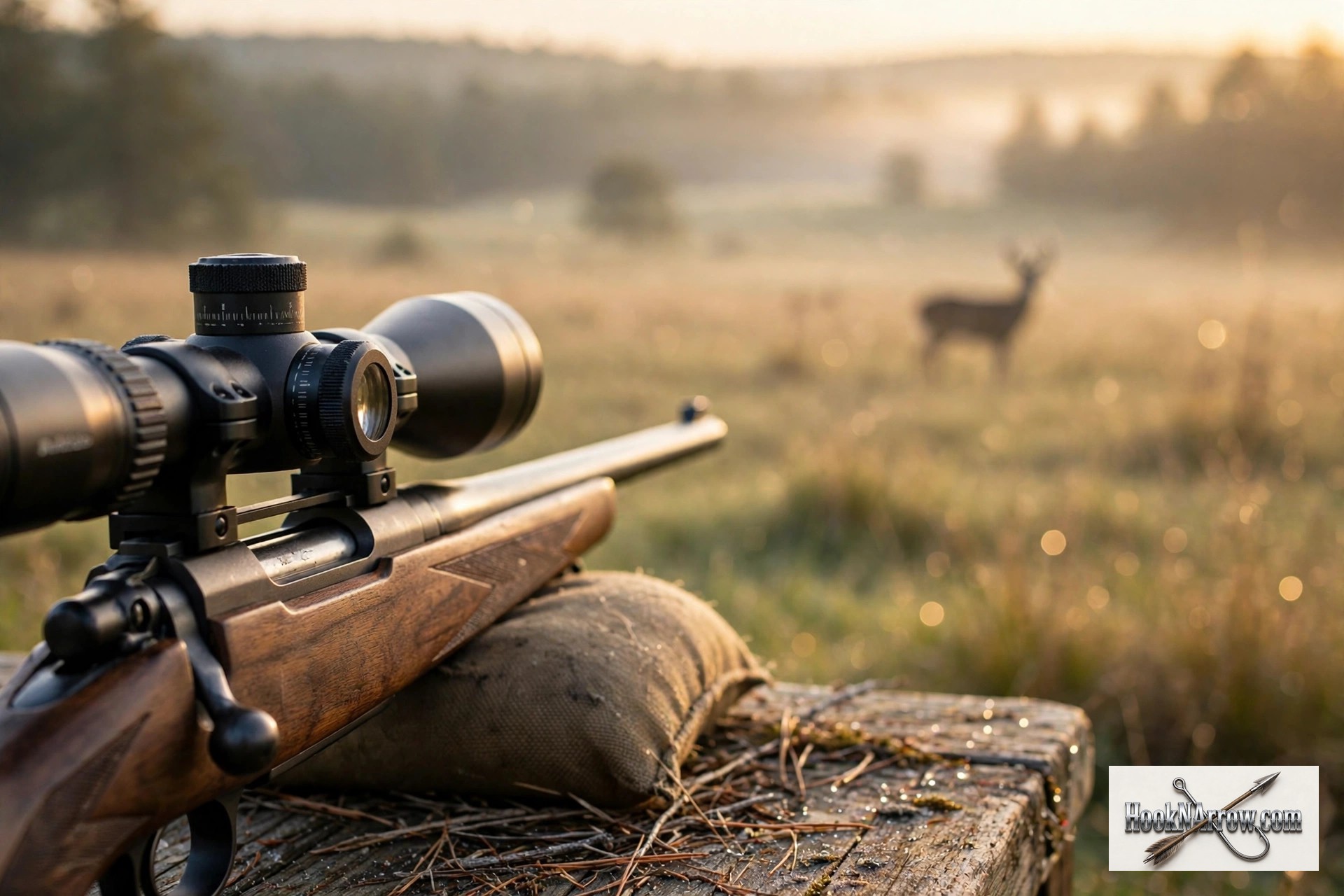
Texas deer hunting happens in three different worlds, and your scope has to work in whichever one you hunt. In South Texas brush country, you’re glassing down a sendero — a long cleared lane cut through the mesquite — where a mature buck might step out at 250 yards and give you seconds. In the Hill Country, you’re in a box blind over a feeder at dawn or dusk, when the light is thin and the deer materialize out of the gray. In the Piney Woods of East Texas, you’re in a thicket where 80 yards is a long shot and the scope mostly needs to find the deer fast in heavy cover.
As an Amazon Associate I earn from qualifying purchases.
All three scenarios share one Texas truth: the best hunting light is the first and last thirty minutes of the day, and that’s exactly when cheap glass fails. A scope’s low-light performance — how bright and clear the image stays as the sun drops — is the single most important quality for a Texas deer hunter. Magnification matters less than most people think. A clear 3-9x that gathers light at dusk will kill more deer than a murky 4-16x.
This guide explains what to look for in a deer scope and covers five proven scopes that fit real Texas hunting, from budget-friendly to buy-once glass.
What to Look For
Magnification. The classic deer scope is a 3-9x: 3x on the low end for close, fast shots in thick cover, 9x on the high end for reaching across a sendero or a wheat field. For most Texas hunting, 3-9x or 2.5-10x is the sweet spot. Higher magnification (4-12x, 3-15x) helps on long sendero shots in South Texas but narrows your field of view and exaggerates wobble — don’t buy more zoom than your shooting supports.
Objective lens size is the diameter of the front lens, in millimeters — the “40” in 3-9×40. A bigger objective gathers more light, which helps at dawn and dusk. But it also sits higher on the rifle, adds weight, and costs more. For Texas: 40mm is the versatile standard. 50mm buys you extra minutes of shooting light from a box blind. Above that, you’re adding bulk for diminishing returns in most deer scenarios.
Low-light performance comes from the combination of objective size, lens coatings, and glass quality. Fully multi-coated lenses (every air-to-glass surface coated) are the baseline — don’t buy a scope without them. Beyond that, glass quality is what separates a $150 scope from a $400 scope at last light. This is where spending more pays off most directly in Texas.
Reticle. The standard duplex (thin crosshairs that thicken toward the edges) is fast, simple, and all most Texas deer hunters need. BDC (bullet drop compensating) reticles add holdover marks for longer shots — useful on senderos where you might need to hold for 300 yards. Illuminated reticles light up the crosshair in low light and are genuinely helpful in a dark box blind at dawn, but they add cost and a battery to manage.
Turrets and adjustments. For a deer rifle, capped turrets you set once and leave alone are ideal — there’s nothing to snag on brush or get bumped in the blind. Exposed tactical turrets are for dialing long-range shots; they’re unnecessary for most Texas deer hunting and a liability in the brush.
Durability. Texas hunting is hard on gear: bouncing down ranch roads, dust, sudden temperature swings, the occasional drop at the lease. Look for a one-piece tube (usually 1 inch; 30mm tubes are sturdier and gather slightly more light adjustment range), nitrogen or argon purging for fog-proofing, and a waterproof rating. A scope that fogs inside on a cold Hill Country morning is useless.
Eye relief — the distance your eye sits from the scope — matters for comfort and safety. Around 3.5 to 4 inches is standard and keeps the scope off your brow on a hard-kicking rifle.
Our Picks
Leupold VX-Freedom 3-9×40 — best all-around Texas deer scope
The VX-Freedom is the modern heir to Leupold’s legendary Vari-X line, and it’s the scope we’d put on a Texas deer rifle if we could only pick one. The glass is bright at dawn and dusk, the duplex reticle is fast, and Leupold’s Twilight Light Management System genuinely extends usable shooting light — which is the whole game in a Hill Country box blind. It’s made in the USA and backed by Leupold’s lifetime warranty, which they honor without drama.
Who it’s for: The hunter who wants one scope that works everywhere in Texas — senderos, box blinds, and Piney Woods thickets.
Pros: Excellent low-light clarity for the price; lightweight; Leupold’s lifetime warranty is the best in the business; the 3-9×40 configuration is the proven Texas deer standard.
Cons: Costs more than budget competitors; the basic duplex reticle has no holdover marks for long sendero shots (BDC versions exist but cost more); turret adjustments are functional rather than refined.
Purchase this item on Amazon →
Vortex Diamondback 3-9×40 — best value mid-range scope
The Diamondback line is where Vortex’s reputation was built: solid glass, rugged construction, and a price that leaves money for ammo and lease fees. The 3-9×40 Diamondback gathers light well at the edges of the day and the Dead-Hold BDC reticle option gives you holdover points for those longer South Texas shots without needing to dial.
Who it’s for: The hunter who wants mid-range performance — better than budget glass — without stepping up to premium prices.
Pros: Strong optical quality for the money; Vortex’s VIP lifetime warranty covers accidental damage, no questions asked; the BDC reticle version is genuinely useful on senderos; good eye relief.
Cons: Slightly heavier than the Leupold; low-light performance is good but a half-step behind the VX-Freedom at last light; the BDC reticle takes practice to use correctly — confirm your holds at the range.
Vortex Crossfire II 3-9×40 — best budget scope
The Crossfire II is the best-selling budget scope in America for a reason: it’s the cheapest glass we’d actually trust on a deer rifle. Fully multi-coated lenses, a simple duplex reticle, and Vortex’s unconditional lifetime warranty. It won’t match the VX-Freedom at dusk, but it will get the job done for the hunter watching their budget.
Who it’s for: New hunters, youth rifles, or a second/loaner rifle at the lease where you need reliable and affordable.
Pros: Very affordable; backed by the same VIP warranty as scopes costing three times more; simple and rugged — not much to break; capped turrets won’t get bumped in the brush.
Cons: Low-light performance is the compromise — you’ll lose shooting light earlier than with better glass; the image gets soft at 9x; eye box is less forgiving than pricier scopes.
Purchase this item on Amazon →
Bushnell Banner 3-9×40 — best ultra-budget scope
The Banner has been around for decades, and the current Dusk & Dawn Brightness (DDB) multi-coated versions are honest scopes for the money. This is the scope for the beater rifle, the truck gun, or the hunter who needs glass now and will upgrade later. Keep expectations realistic: it’s a $100-class scope, not a $400 one.
Who it’s for: The tightest budgets — a first deer rifle, a camp loaner, or a backup.
Pros: Among the cheapest scopes worth mounting; the DDB coatings help at dawn and dusk for the price; simple duplex reticle; light and compact.
Cons: Noticeably less bright than the Crossfire II at last light; adjustments and tracking are basic — sight it in and leave it; long-term durability under hard ranch-road use is the question mark.
Purchase this item on Amazon →
Burris Fullfield E1 3-9×40 — best scope for long sendero shots
The Fullfield E1’s standout feature is its Ballistic Plex E1 reticle, with cascading holdover dots for longer shots — purpose-built for exactly the South Texas sendero scenario where a buck hangs up at 300 yards. Burris glass is solid, the scope is rugged, and the price sits in the mid-range. If your hunting is mostly long lanes in the brush country, this reticle earns its keep.
Who it’s for: South Texas hunters shooting senderos, power lines, and food plots where 200- to 300-yard shots are realistic.
Pros: The E1 reticle’s holdover points are genuinely useful past 200 yards; good glass and build quality for the price; Burris’s Forever Warranty; positive, repeatable adjustments.
Cons: The busy reticle is overkill for East Texas thickets where shots are under 100 yards; a step up in price from the budget options; heavier than the Leupold.
Texas Tips
- South Texas senderos: Consider a 3-9x or 4-12x with a BDC-style reticle (Diamondback with Dead-Hold BDC or Burris Fullfield E1). Practice your holdovers at the range before the season — guessing at 300 yards on a live buck is how you wound deer.
- Hill Country box blinds: Prioritize low-light performance above all. A 3-9×40 or 3-9×50 with the best glass you can afford pays off at dawn and dusk. Keep a lens cloth in the blind — morning condensation on the objective costs you the first minutes of light.
- East Texas Piney Woods: Keep magnification low. A 2-7x or 3-9x set on 3x or 4x gives you a wide field of view to find a deer moving through thick cover. High magnification is a liability when a buck appears at 60 yards.
- Sight in for Texas distances. A 200-yard zero (roughly 2 inches high at 100) keeps you in the kill zone from point-blank to 250 without holding over — which covers the vast majority of Texas shots. Confirm at the range; don’t trust the box.
- Protect your glass on ranch roads. A padded scope cover or even a sock over the scope during the drive saves your lenses from the caliche dust that coats everything in South and West Texas. Wipe with a lens cloth, never your shirt tail — dust scratches coatings.
FAQ
What magnification do I need for Texas deer hunting? A 3-9x covers nearly all of it. Go 2-7x if you hunt exclusively thick East Texas cover; consider 4-12x only if most of your shots are long sendero or field shots in South Texas.
Is a 50mm objective worth it? In a box blind at dawn and dusk, yes — the extra light gathering buys you real minutes. For still-hunting or thick cover, the added height and weight aren’t worth it. A quality 40mm with good coatings beats a cheap 50mm every time.
Do I need an illuminated reticle? Not necessarily, but it’s a real advantage in a dark box blind at first and last light, when black crosshairs disappear against a dark deer. If you hunt a lot of low-light situations, it’s worth the premium. Otherwise, a standard duplex is fine.
Should I buy a used Nikon ProStaff? We’d pass. Nikon left the riflescope market, so there’s no factory warranty or support on new purchases, and used scopes are always a gamble on internal condition. The Vortex and Bushnell budget options above come with real lifetime warranties for similar money.
How much should I spend on a deer scope? Expect $150–$250 for solid budget glass (Crossfire II, Banner) and $250–$450 for the mid-range sweet spot (VX-Freedom, Diamondback). The mid-range is where most Texas hunters should land — spend more only if you have specific long-range needs.
What about buying a rifle online — does it ship to my door? No. Firearms bought online must ship to a licensed FFL dealer near you, where you’ll complete the federal background check and transfer paperwork before taking the rifle home. (Scopes and other optics like the ones above ship straight to your door — no FFL needed.)
Keep Reading: More Buying Guides
More Hunting Gear Guides
- Best Trail Cameras for Whitetail Deer 2026
- Best Hunting Knives for Deer & Hog Hunting (2026)
- Best Binoculars for Hunting 2026
- Best Thermal Scopes for Hog & Predator Hunting (2026 Guide)
- Best Bear Hunting Gear 2026
- Best Elk Hunting Gear 2026
- Best Mountain Lion Hunting Gear 2026