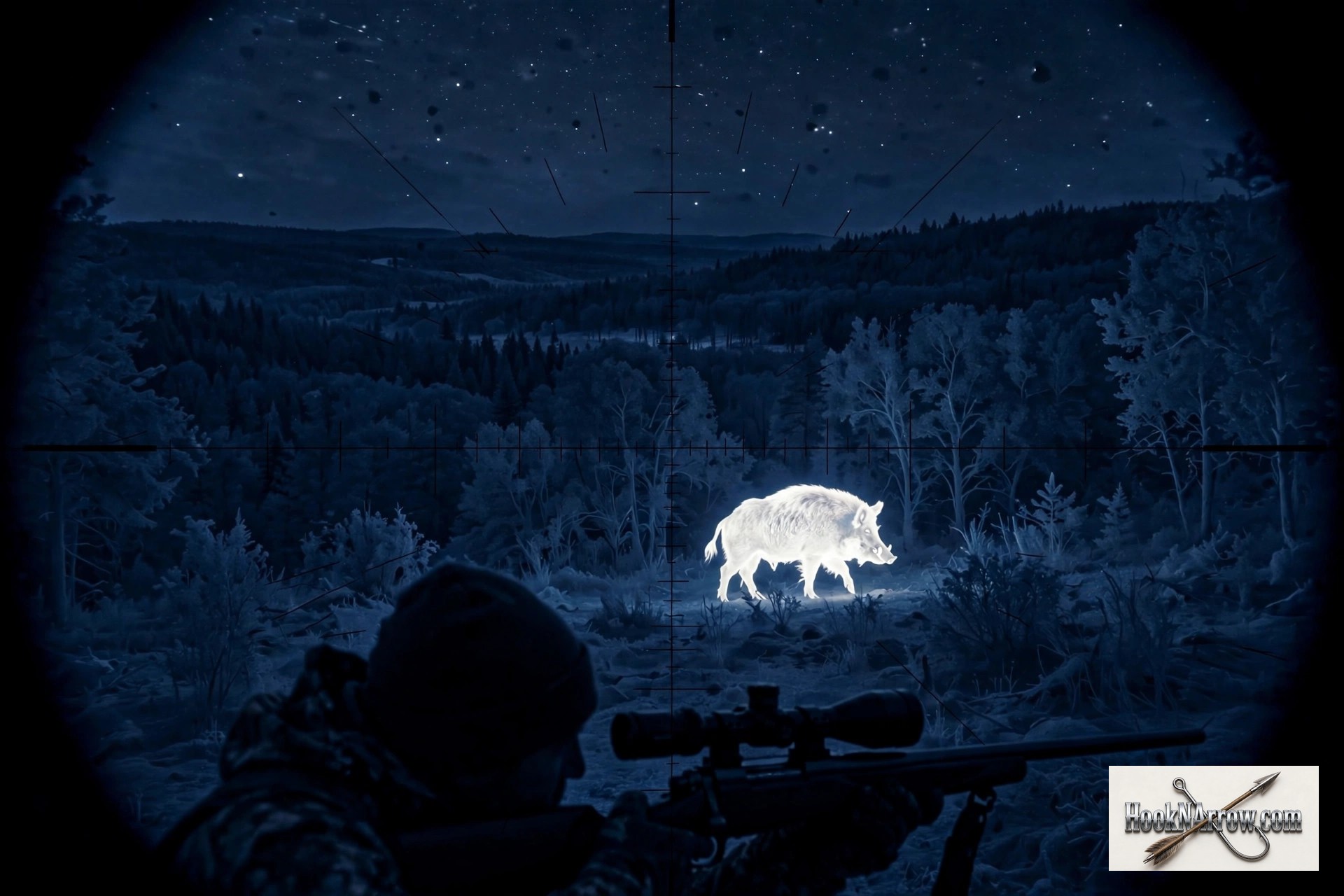
Hog hunting in the South and coyote hunting across the West and Midwest happen in the dark — that’s when the animals move. A thermal scope doesn’t need moonlight, starlight, or an IR illuminator that spooks game. It reads heat, so a hog rooting in brush or a coyote crossing a pasture at 200 yards shows up bright against the cold ground. And for blood-trailing a deer after sunset, a handheld thermal monocular will pick up a warm body in cover faster than any flashlight ever will.
As an Amazon Associate I earn from qualifying purchases.
Thermal pricing is driven almost entirely by the sensor. A 256-resolution sensor costs a fraction of a 640 sensor, and for hogs inside 150 yards it’s plenty. Step up to 384 when you want to identify coyotes at distance, and 640 when you want the clearest picture in a handheld scanner. Everything else — refresh rate, battery, recording — matters, but sensor resolution is the price ladder. Buy the sensor your hunting actually needs, not the one the spec sheet brags about.
This guide explains what to look for in thermal optics and covers five optics that fit real night hunting: three weapon-mounted thermal scopes and two handheld monoculars for scanning and recovery.
What to Look For
Sensor resolution. This is the big one. 256×192 is the entry point — fine for hogs inside 150 yards. 384×288 is the sweet spot for most night hunters: enough detail to identify a coyote at a couple hundred yards without the premium price. 640×480 is the top tier — the clearest image, the longest reach, and the highest cost. Resolution is measured in pixels, and more pixels mean you can tell what you’re looking at from farther away.
Refresh rate is how many times per second the image updates, measured in hertz. 50Hz or 60Hz is the standard for hunting thermals — the image stays smooth when you pan across a field. Below that, the picture smears and lags, which is miserable when a sounder of hogs is moving. Every optic in this guide runs at 50Hz or faster.
Detection range is how far away a man-sized heat source registers on the sensor — not how far you can identify it. Detection is always much farther than identification. For hogs under 150 yards, 900+ yards of detection is plenty. Coyote hunters in open country should look for 1,200 yards or more so they can spot dogs coming in from a long way off.
Magnification and field of view. Thermal scopes use low base magnification (usually 1.5x to 2.5x) with a wide field of view for finding animals, plus digital zoom for identifying them. That’s the right design — high base magnification narrows your view and makes it hard to find hogs in brush. Zoom in to confirm, zoom out to scan.
Battery life. Night hunts run long, and cold weather drains batteries faster. Look for 7 or more hours of real-world runtime. Removable, rechargeable battery packs beat disposable AAs — you can carry a spare and swap in the dark. USB charging is a plus for topping off from the truck.
Durability. Your thermal rides on a rifle, so it needs to be recoil-rated for your caliber and sealed against weather — IP67 or equivalent waterproofing is the baseline. A thermal that can’t handle centerfire recoil or a rainstorm is an expensive paperweight.
Recording and Wi-Fi. Onboard video recording is genuinely useful: reviewing shots, settling arguments about who missed, sharing with buddies. Wi-Fi lets you stream the view to a phone, which is handy when hunting with a partner. Neither is essential, but both are nice to have.
Our Picks
AGM Rattler V2 TS 25-384 — best all-around thermal scope
The Rattler V2 25-384 is the 384-class thermal scope we’d recommend to most night hunters. The 384×288 sensor with a 50Hz refresh rate gives you clean identification on hogs and coyotes at real hunting distances, the 2x base magnification keeps a wide 10.5-degree field of view for finding animals, and the 1,200-yard detection range covers open-country calling stands. The removable rechargeable battery runs up to 11.5 hours, and onboard recording with shot activation means every shot is captured without thinking about it.
Who it’s for: The hog or predator hunter who wants one thermal scope that does everything — southern hogs, western coyotes, and everything between.
Pros: The 384 sensor hits the price-to-performance sweet spot; genuinely long battery life; shot-activated recording; wide field of view at 2x for scanning from the rifle.
Cons: Costs meaningfully more than 256-class scopes; digital zoom gets grainy past 8x — identify before you zoom that far; the menu system takes an evening to learn.
Purchase this item on Amazon →
ATN ThOR 4 384×288 — best feature-packed smart scope
The ThOR 4 is the tech-heavy option: a Gen 4 384×288 sensor running at 60Hz, a built-in ballistic calculator, HD video recording, Wi-Fi and Bluetooth, a smart rangefinder, and an 18-plus-hour battery. It mounts in standard 30mm rings like a regular scope, has 90mm of eye relief, and comes in multiple magnification configurations (1.25-5x up to 7-28x) so you can match it to your terrain. If you like your gear loaded with features, this is the one.
Who it’s for: The tech-minded hunter who wants ballistics, recording, and connectivity built into the scope — and hunts long enough nights to need that big battery.
Pros: Huge 18+ hour battery life; built-in ballistic calculator with multiple profiles; long 90mm eye relief is comfortable; several magnification options to choose from.
Cons: Bulkier and heavier than the AGM; the app, menus, and smart features have a real learning curve; premium pricing for the feature set.
Purchase this item on Amazon →
Pulsar Axion 2 XG35 — best premium handheld scanner
Not a scope — a monocular. And that’s the point: you scan with this and shoot with your rifle scope. The Axion 2 XG35 packs a 640×480 sensor with 2.5-20x magnification and roughly 1,900 yards of detection into a pocket-sized magnesium body, with a crisp 1024×768 AMOLED display, 16GB of onboard recording, Wi-Fi, and IPX7 waterproofing. It’s the clearest handheld picture in this guide and the right tool for scanning big country or finding a downed deer in the dark.
Who it’s for: The serious night hunter who glasses large areas before ever shouldering a rifle — and anyone who wants the best tool for blood-trailing after dark.
Pros: The 640 sensor delivers the clearest image here; genuinely pocket-sized; rugged magnesium housing; huge detection range for open country.
Cons: Expensive — 640 sensors always are; 7-hour battery is the shortest in this guide, so bring a power bank; it’s a scanner, not a weapon sight.
Purchase this item on Amazon →
AGM Rattler V2 TS 19-256 — best budget thermal scope
The 19-256 is the same Rattler V2 platform as our top pick with a 256×192 sensor instead of 384. You still get the 50Hz refresh rate, the 1024×768 OLED display, 16GB of recording, Wi-Fi, shot-activated recording, and the 11.5-hour removable battery — just with 950 yards of detection instead of 1,200. For hog hunting inside 150 yards, which is where most southern night hunting happens, the 256 sensor does the job at a much friendlier price.
Who it’s for: The first-time thermal buyer hunting hogs at feeder or bait distances, where shots are close and the budget matters.
Pros: The cheapest way into a real, current-generation thermal scope; same battery, recording, and build as the 384 model; plenty of performance for close-range hog work.
Cons: The 256 sensor shows its limits past about 150 yards when you need to identify rather than just detect; less future-proof if you expand into open-country coyote hunting.
AGM Taipan V2 15-384 — best value scanning monocular
The Taipan V2 15-384 is a dedicated 384×288 handheld scanner with a wide 17.5-degree field of view — wider than any scope here, which is exactly what you want for sweeping a field edge or a brush line. The sub-20mK sensor is sensitive, the 50Hz refresh rate keeps the image smooth, and it’s IP67 waterproof with 16GB of recording and Wi-Fi. Detection runs about 780 meters, which is plenty for scanning the ground you’ll actually hunt.
Who it’s for: The hunter who already owns a thermal scope and needs a dedicated scanner, or anyone who wants an affordable monocular for spotting game and trailing deer.
Pros: Wide field of view is ideal for scanning; 384 clarity at a reasonable price; fully waterproof; compact and light for all-night carry.
Cons: Shorter detection range than the Pulsar; monocular only — it can’t be weapon-mounted; the 15mm lens trades reach for field of view.
Night Hunting Tips
- Scan with the monocular, shoot with the scope. Glassing with your rifle scope means pointing a loaded rifle at everything you look at. Scan handheld, identify your target, then shoulder the rifle. It’s safer and you’ll spot more game.
- Learn both palettes. White-hot (heat shows white) is the default most hunters use. Black-hot (heat shows black) can pick out animals in brush better on some nights. Switch between them — one usually wins depending on terrain and temperature.
- Cold nights are your friend. Thermal works on temperature contrast, so the colder the night, the brighter animals stand out. The tradeoff is battery life — cold drains batteries faster, so keep spares in a warm pocket.
- Zero in daylight. Most thermal scopes let you zero on a warm target — a hand warmer taped to cardboard works. Get it done before dark so you’re not burning hunting time at the range after sunset.
- Know the law before you go. Thermal legality varies by state and by species — see the FAQ below. Check current regulations every season; they change.
- Hogs travel in groups. Where there’s one hog on thermal, there are usually more behind it. Stay ready for follow-up shots, and if you’re hunting over bait where legal, let the whole sounder commit before shooting.
FAQ
Are thermal scopes legal for hunting? It depends on your state and what you’re hunting. Many states allow thermal optics for hogs and predators like coyotes — often with fewer restrictions than for game animals — while others restrict or ban thermal for deer and other big game. Some states allow owning the optic but restrict how it can be used, and rules change, so always check your state’s current hunting regulations before buying or heading out. When in doubt, call your state wildlife agency.
What’s the difference between thermal and night vision? Thermal detects heat signatures — it works in total darkness, through light brush, and doesn’t need any light source. Traditional night vision amplifies existing light (moonlight, starlight) and usually needs an IR illuminator in true darkness, which can spook game. For finding animals at night, thermal is the more capable technology; night vision gives a more natural-looking image.
Do I need both a monocular and a scope? Not to start. A weapon-mounted thermal scope alone will get you hunting. But most serious night hunters end up with both: the monocular for scanning (safer and more comfortable than glassing through your scope) and the scope for the shot. If budget forces a choice, buy the scope first.
How far can thermal detect versus identify? Detection — seeing that something warm is there — runs two to four times farther than identification, which is telling a hog from a deer from a calf. A scope rated for 1,200-yard detection might give you confident identification at 300 to 400 yards. Buy for the identification distance you hunt at, not the detection number on the box.
Does thermal work in fog or rain? Light moisture is fine, but heavy fog, rain, and high humidity all degrade thermal performance — water in the air absorbs the infrared energy. On truly socked-in nights, even good thermal struggles. That’s hunting; some nights just aren’t thermal nights.
How much should I spend on a thermal optic? Budget 256-class scopes start the conversation for close-range hog hunting. The 384 class — roughly the middle of the market — is where most hog and predator hunters should land for the best balance of identification range and price. Handheld 640 monoculars sit at the top for scanning. Match the sensor to the distances you actually hunt.
Keep Reading: More Buying Guides
More Hunting Gear Guides
- Best Trail Cameras for Whitetail Deer 2026
- Best Hunting Knives for Deer & Hog Hunting (2026)
- Best Deer Hunting Scopes 2026
- Best Binoculars for Hunting 2026
Leave a Reply