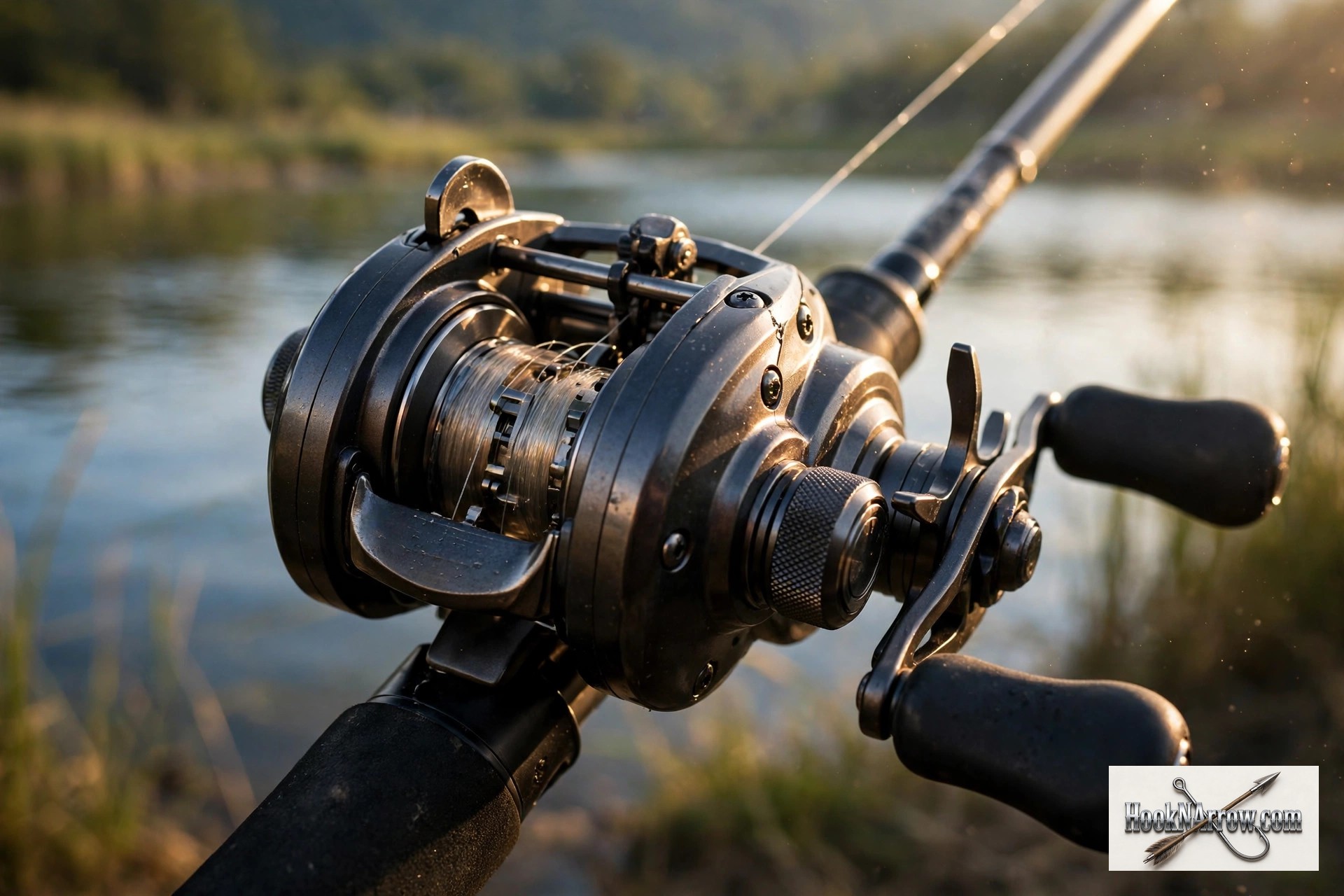
A baitcasting reel is the business end of a Texas bass setup. The rod casts it, but the reel fights the fish — and Texas fish fight dirty. A six-pounder at Lake Fork that wraps you around a flooded tree will test every part of your reel: the drag, the gears, the frame. Pick wrong and you’ll know it at the worst possible moment.
As an Amazon Associate I earn from qualifying purchases.
Texas bass fishing also asks one reel to do very different jobs. Flipping heavy cover at Fork demands a fast reel that takes up slack in a hurry when a fish charges the boat. Deep cranking at Toledo Bend or Sam Rayburn demands the opposite — a slower reel with the torque to grind a big plug through 20 feet of water all day without wearing out your wrist. Frogging matted hydrilla needs speed and power together. Understanding gear ratio is the key to matching the reel to the technique, and that’s where this guide starts.
What to Look For
Gear ratio is the number of times the spool turns for one crank of the handle. It defines what the reel is for:
- Around 5:1 to 6:1 (slow): Deep cranking. The lower ratio gives you cranking power and torque, so you can grind a deep-diving plug or a big swimbait without the reel feeling strained. Slow reels also keep you from burning a bait too fast.
- Around 6:1 to 7:1 (medium): The all-around range. Spinnerbaits, Texas rigs, jigs, medium crankbaits. If you own one baitcaster, this is the ratio.
- Around 7:1 to 8:1+ (fast): Flipping, pitching, frogging, and topwater. Fast reels pick up line quickly so you can get a fish moving toward you before she buries in cover, and they take up slack fast on the hookset.
Don’t confuse gear ratio with inches per turn (IPT) — how much line is actually retrieved per handle crank. IPT depends on spool size too. Bigger spools retrieve more line per turn at the same ratio. Check the manufacturer’s specs if IPT matters to your technique.
Braking system controls the spool during the cast so you don’t get a backlash (a “bird’s nest”). Two main types:
- Magnetic brakes: An adjustable dial changes magnetic resistance on the spool. Simple, consistent, and easy to adjust on the fly — great for beginners and for windy Texas afternoons when conditions change cast to cast.
- Centrifugal brakes: Small brake blocks fling outward against a brake ring at high spool speeds, taming the start of the cast. Very effective once tuned, and many reels combine both systems.
Digital braking (like Shimano’s DC system) uses a microcomputer to adjust braking thousands of times per second. It’s the easiest casting experience in baitcasting, at a premium price.
Bearings are often marketed as “more is better,” but quality beats quantity. A reel with five good stainless or shielded bearings will outlast and outcast a reel with twelve cheap ones. What matters more: a smooth drag, solid gears, and a rigid frame.
Line capacity and drag matter for Texas. Heavy cover fishing means 50- to 65-pound braid, and you want enough capacity that a long cast doesn’t leave you near the knot. Drag should be smooth and strong — look for at least 10+ pounds of max drag on a heavy-cover reel, and test that it pays out smoothly rather than in jerks.
Frame material affects weight and rigidity. Aluminum frames are stiff and durable — they hold gears in alignment under heavy loads, which matters when you’re winching a fish out of Fork timber. Composite/graphite frames are lighter and fine for general use but can flex under extreme pressure.
Our Picks
Shimano Curado 200K — best all-around Texas baitcaster
The Curado is the default answer for a reason. Generations of Texas anglers have fished Curados, and the 200K continues the line’s reputation: a rigid aluminum frame, smooth drag, and Shimano’s dependable gearing. Available in multiple gear ratios (including 6.2:1, 7.4:1, and 8.5:1 versions), so you can buy the ratio that matches your technique — 7.4:1 for the all-arounder, 8.5:1 for flipping and frogging.
Who it’s for: The angler who wants one reel that does nearly everything well, from Texas rigs at Rayburn to spinnerbaits on Texoma.
Pros: Proven durability over years of hard use; multiple gear ratios to match techniques; strong, smooth drag; the aluminum frame stays rigid pulling fish from heavy cover.
Cons: Priced above budget reels, so outfitting five rods gets expensive; not the lightest reel in its class; the stock handle knobs divide opinion on long casting days.
Daiwa Tatula 100 — best casting distance
Daiwa’s T-Wing System (the T-shaped line guide that opens wide on the cast) genuinely reduces friction and adds distance — noticeable when you’re bombing casts to far offshore structure at Toledo Bend or skipping under docks at Lake Conroe. The Tatula 100 is compact, light, and casts light lures better than most reels in its price range.
Who it’s for: Anglers who value casting distance and light-lure performance — dock skipping, light Texas rigs, weightless plastics.
Pros: Excellent casting distance thanks to the T-Wing guide; light and comfortable for all-day casting; strong value against premium competitors; handles lighter lures better than most.
Cons: The T-Wing takes some getting used to if you’re coming from a standard guide; max drag is adequate but not class-leading for the heaviest flipping; some anglers prefer Shimano’s braking feel.
Abu Garcia Revo SX — best mid-range workhorse
The Revo SX has been a staple recommendation for years because it does everything competently at a fair price. The D2 gear design and a solid drag system handle Texas bass without complaint, and it’s available in the standard ratios (including 6.6:1 and 7.3:1) that cover most techniques.
Who it’s for: The angler building out a full set of technique-specific rods who needs reliable reels at every station without premium prices.
Pros: Strong price-to-performance ratio; durable D2 gearing; comfortable ergonomics for long days; widely available with good parts support.
Cons: Braking adjustment is less refined than Shimano or Daiwa’s best systems; finish can show wear after seasons of hard use; not a standout in any single category — it’s good at everything, best at nothing.
Lew’s Tournament Pro Speed Spool — best for flipping and frogging
Lew’s built its name on fast, light reels, and the Tournament Pro is the flagship of the Speed Spool line. In the 8.3:1 ratio, it takes up line in a hurry — exactly what you want when a Fork bass inhales a jig in flooded timber and turns toward the boat, or when you’re walking a frog across matted hydrilla and need to drive hooks home and move the fish now.
Who it’s for: Flipping, pitching, and frogging in heavy Texas cover.
Pros: Very fast retrieve options for heavy-cover techniques; light in hand, which matters pitching all day; strong drag for the price class; Lew’s has deep roots with tournament anglers.
Cons: The fastest ratios are poor choices for crankbaits — buy the right ratio for the job; long-term gear durability under heavy flipping loads is good but not legendary; premium pricing within the Lew’s lineup.
Shimano SLX DC — best backlash-proof reel for beginners
Shimano’s Digital Control braking adjusts itself thousands of times per second during the cast, which means dramatically fewer backlashes. For a beginner — or anyone fishing the gusty Texas wind that swirls across open lakes like Texoma and Falcon — it’s the most forgiving casting experience short of a spinning reel. It’s priced well below Shimano’s premium DC reels, making the technology accessible.
Who it’s for: New baitcaster users, kids, or anyone who’d rather fish than pick out backlashes — especially in Texas wind.
Pros: Digital braking makes backlashes rare, even for beginners; casts well into the wind; solid Shimano build quality at a mid-range price; great confidence builder for learning baitcasters.
Cons: The DC system adds weight and complexity; experienced casters may find it limits maximum distance slightly versus a well-tuned manual brake; the electronic braking is a love-it-or-leave-it feel.
Purchase this item on Amazon →
Texas Tips
- Match ratio to technique, not habit. The biggest mistake Texas anglers make is fishing one ratio for everything. A 5:1-range reel for deep cranking at Toledo Bend, a 7:1-range for all-around work, and an 8:1 for flipping Fork timber will each catch you more fish than one compromise reel.
- Spool for the cover. Flipping and frogging: 50- to 65-pound braid, straight to the lure. Texas rigs and jigs in moderate cover: 15- to 20-pound fluorocarbon. Crankbaits: 10- to 14-pound fluorocarbon for depth and stretch.
- Wind is a constant. Texas lakes are windy — Falcon, Amistad, and Texoma especially. When the wind kicks up, tighten your brakes a click or two and thumb the spool. A backlash in 20 mph wind costs you fishing time you won’t get back.
- Rinse after salt or brackish trips. If you fish the coast or brackish bays for reds on the same reels, rinse with fresh water and dry them. Salt kills baitcasters fast.
- Heat and drag washers. Don’t leave reels baking on the boat deck in August. Prolonged extreme heat can degrade drag grease over time. Store rods and reels in shade or a locker between trips.
FAQ
What gear ratio is best for Texas bass fishing? There’s no single answer — that’s the point. Around 7:1 is the best all-around ratio. Go slower (5:1–6:1) for deep crankbaits and faster (7.5:1–8:1+) for flipping, pitching, and frogging in heavy cover.
Are expensive baitcasting reels worth it? Up to a point, yes. The jump from a $60 reel to a $150–$200 reel (Curado, Tatula, Revo SX class) buys noticeably better gears, drag, and durability — and that matters when Texas fish test your equipment. Beyond that, you’re paying for weight savings and refinement, which is personal preference.
Magnetic or centrifugal brakes? Both work. Magnetic brakes are simpler to adjust on the fly, which helps when Texas wind changes by the hour. Centrifugal (or combo) systems give experienced casters more distance. Beginners should strongly consider digital braking like the SLX DC.
How do I stop backlashes? Start with brakes set firm and loosen gradually as you learn. Keep your thumb lightly on the spool, especially as the lure lands. Heavier lures are easier to learn on than light ones. And fish into the wind with tighter brakes — the wind is the number-one backlash machine in Texas.
Can I use one reel for both freshwater bass and inshore saltwater? You can, but rinse it thoroughly with fresh water after every salt trip and service it more often. Many Texas anglers keep separate reels for the coast because salt corrosion is relentless — a dedicated inshore reel saves your bass reels.
Keep Reading: More Buying Guides
More Hunting Gear Guides
- Best Trail Cameras for Whitetail Deer 2026
- Best Hunting Knives for Deer & Hog Hunting (2026)
- Best Deer Hunting Scopes 2026
- Best Binoculars for Hunting 2026
- Best Thermal Scopes for Hog & Predator Hunting (2026 Guide)
- Best Bear Hunting Gear 2026
- Best Elk Hunting Gear 2026
- Best Mountain Lion Hunting Gear 2026
Leave a Reply