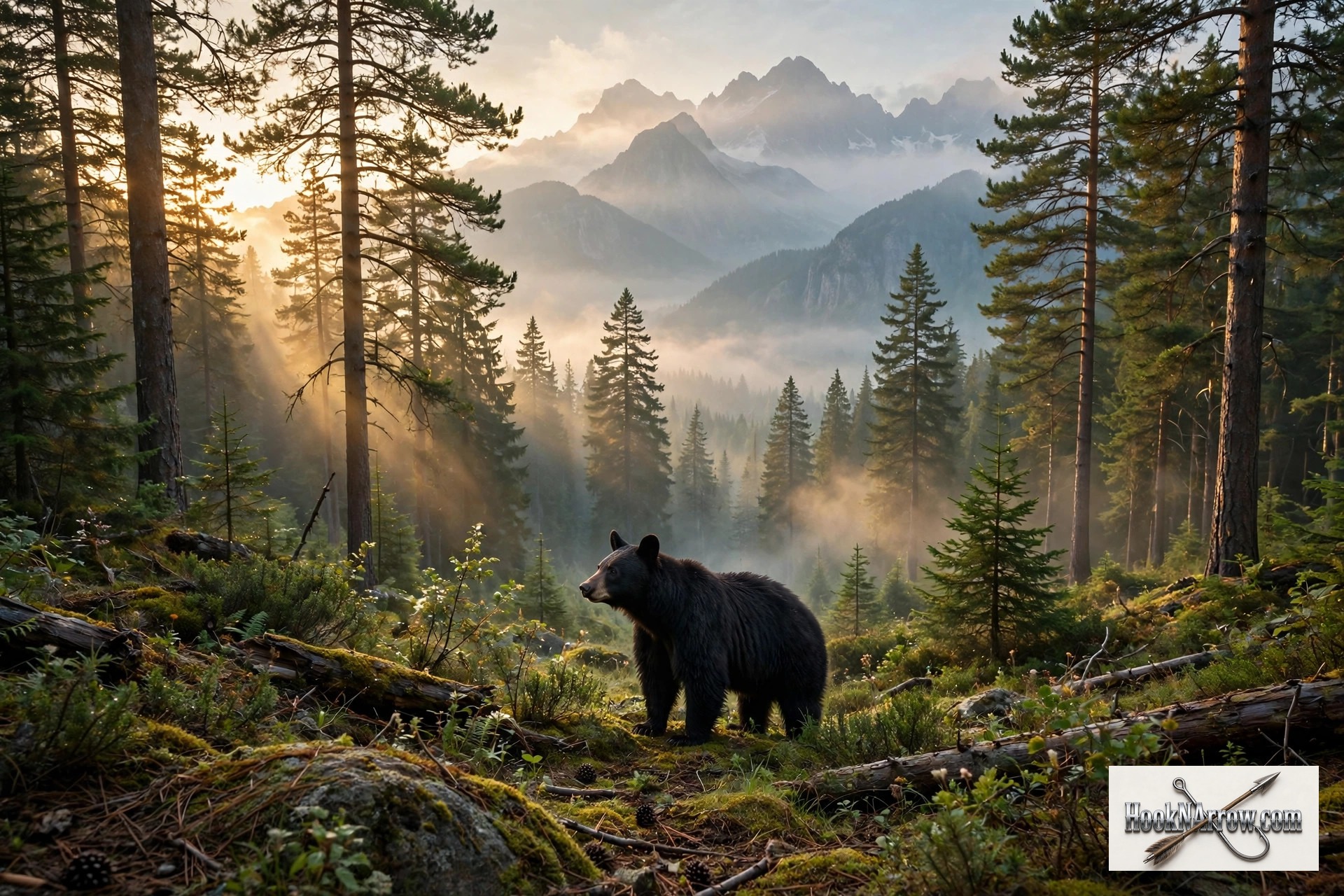
Black bear hunting is one of the most underrated big-game hunts in North America. Spot-and-stalk on western mountainsides in the spring, sitting a bait in the Northwoods in September, or still-hunting berry patches in the fall — there are bear seasons in more than half the states and most of Canada, tags are affordable compared to elk or moose, and success rates on a well-run hunt are high. But bears demand a different kind of preparation than deer. You’re hunting an animal that can weigh 300 pounds, has a nose better than a whitetail’s, and lives in country where you might be miles from the truck when the work starts.
The gear that matters most for bear hunting isn’t the rifle or the bow — it’s everything around the shot. Bear spray on your hip, glass good enough to judge a bear at 400 yards, a pack that can haul meat, a knife that stays sharp through a thick hide and a heavy fat layer, and game bags that keep the meat clean on the way out. Get those five things right and the rest of the hunt takes care of itself.
This guide from HookNArrow.com explains what to look for in bear hunting gear and covers five field-proven picks: bear spray for safety, a meat-hauling pack, binoculars for spotting and judging bears, a replaceable-blade field knife, and breathable game bags for meat care.
What to Look For
Bear spray. Carry EPA-registered bear deterrent — not personal-defense pepper spray, which is a different product with a shorter range. Real bear spray shoots 30 to 40 feet, empties in 7 to 8 seconds, and uses 2% capsaicin. Range and spray duration matter more than canister size: you want a long, wide cloud between you and the bear, not a short squirt. It has to ride on your body in a holster — hip or chest — not buried in your pack, and check the expiration date every season.
A pack that hauls meat. A mature black bear is 200 to 400-plus pounds of animal, and you’re quartering and packing it out — often uphill, often in the dark. A daypack won’t cut it. Look for a framed pack with a dedicated meat shelf or load-hauling design, a suspension that stays comfortable under 80 to 100 pounds, and tough, quiet fabric. If the pack can’t comfortably carry a heavy, awkward load for miles, it isn’t a bear hunting pack.
Optics for judging bears. Most bear hunting is really bear judging — telling a mature boar from a sow or a young bear before you ever think about shooting. That happens through binoculars at dawn and dusk, when bears move and light is thin. A 10×42 binocular with good low-light glass is the standard: enough magnification to read ears and body shape at a few hundred yards, wide enough field of view to find bears in brush, and fully waterproof because bear country weather doesn’t care about your plans.
A knife that stays sharp. Field dressing a bear is harder knife work than a deer: thicker hide, a heavy layer of fat, and a lot more animal. A traditional blade goes dull halfway through the job, and nobody sharpens well with bloody hands in fading light. Replaceable-blade knives solve it — when the edge fades, swap in a scalpel-sharp blade in seconds and keep working. Carry spare blades; you’ll use them.
Game bags for meat care. Bear meat spoils faster than most hunters expect. The thick fat layer holds body heat, and early fall days can be warm. The fix is speed: get the hide off, get quarters into breathable game bags that keep flies and dirt out while letting heat escape, and get the meat cooling. Look for bags sized for quarters, made from breathable woven material (not plastic), washable and reusable, that pack down small in your pack until you need them.
Our Picks
Counter Assault Bear Deterrent Spray with Holster (10.2 oz) — best bear safety essential
If you hunt bears, you carry bear spray — even with a rifle on your shoulder. Most charges happen fast and close, and spray has a long record of stopping them without requiring a perfect shot under stress. Counter Assault’s 10.2 oz canister is the one to get: a 40-foot spray range, 8 full seconds of spray time, 2% capsaicin formula, a glow-in-the-dark safety wedge you can find by feel in low light, and a belt holster so it rides on your hip where your hand can reach it. It’s EPA-registered, made in Montana, and every canister is leak-tested with a 4-year shelf life.
Who it’s for: Every bear hunter, period — rifle, bow, or muzzleloader. If you’re in bear country, this rides on your body.
Pros: 40-foot range keeps maximum distance between you and the bear; 8-second spray duration is among the longest available; glow-in-the-dark safety is genuinely useful at dawn and dusk; includes a belt holster.
Cons: The 10.2 oz canister is bulkier than the 8.1 oz version — worth it for the extra range and spray time; check the expiration date and replace every 4 years; practice drawing it before the season, not during a charge.
Purchase this item on Amazon →
Badlands 2200 Hunting Backpack with Built-in Meat Hauler — best pack for packing out a bear
The 2200 is built around the exact problem bear hunting creates: getting a heavy animal out of rough country. The built-in meat shelf separates the load from your gear, the molded memory-foam suspension conforms to your body and stays comfortable under real weight, and the frame uses a proprietary magnesium alloy that’s stronger than aluminum at less weight. It’s got the details that matter too — a detachable rifle/bow boot so your hands are free on the packout, a hip-belt pistol holster, compatibility with Badlands’ bino harness system, and a 2L hydration reservoir sleeve. And it’s covered by Badlands’ unconditional lifetime warranty: they fix it free, forever, no matter who roughed it up.
Who it’s for: The spot-and-stalk or still-hunter who packs in light and packs out heavy — western bear country especially.
Pros: Built-in meat shelf is purpose-designed for hauling quarters; magnesium frame is strong and light; unconditional lifetime warranty is the best in the business; rifle/bow boot keeps hands free.
Cons: At around 5 pounds it’s not ultralight; 2,200 cubic inches fills fast on multi-day trips — it’s a day-to-long-weekend pack; premium price, though the warranty softens that.
Purchase this item on Amazon →
Vortex Optics Diamondback HD 10×42 Binoculars — best glass for spotting and judging bears
Bear hunting success usually comes down to what you see before the shot — and the Diamondback HD 10×42 is the binocular that made premium-feeling glass affordable. The HD optical system with fully multi-coated lenses delivers sharp, bright images in the low light when bears are moving, the 10x magnification is enough to read a bear’s ears and body at distance, and they’re waterproof, fogproof, and shockproof with rubber armor that survives being banged around in bear brush. They come with Vortex’s GlassPak harness — far better than a neck strap for all-day glassing — and the unconditional, transferable VIP lifetime warranty.
Who it’s for: Any bear hunter who glasses — which should be every bear hunter. Especially valuable for judging boars on spot-and-stalk hunts.
Pros: Optical quality punches well above the price; included GlassPak harness is a real upgrade over a neck strap; waterproof and fogproof for nasty weather; VIP warranty covers damage, not just defects.
Cons: At 21 ounces they’re not the lightest 10×42; 10x can be shaky freehand in wind — brace against something; serious long-range judges may eventually want 12x or a spotter too.
Purchase this item on Amazon →
Havalon Piranta-Edge with 12 Replacement Blades (Orange) — best field knife for bears
A bear’s hide and fat layer will dull a conventional knife fast, and a dull knife on a bear is how cuts happen. The Piranta-Edge sidesteps the whole problem: it uses replaceable 60A scalpel blades, so when the edge fades you swap in a fresh one in seconds and keep cutting like you just opened the package. The blaze-orange handle is easy to spot in leaves and low light — no small thing when you set a knife down on a dark bear at dusk — and this version ships with 12 spare blades, which is about right for a bear plus a spare hunt or two. It folds, it’s light, and it’s been the go-to field knife of serious big-game hunters for years.
Who it’s for: Anyone who’ll be putting a knife into a bear — which is everyone who fills a tag.
Pros: Always-sharp blades with zero field sharpening; blaze-orange handle is easy to find if dropped; 12 included blades cover a bear with room to spare; light and folds into a pocket or pack.
Cons: Replacement blades are a consumable cost over time; the thin scalpel blades demand respect — cut away from yourself; not a pry bar — use it for cutting only.
Purchase this item on Amazon →
Koola Buck Game Bags (5-Pack) — best meat care for bear quarters
The hunt isn’t over when the bear is down — it’s over when the meat is cooling clean. Koola Buck’s 5-pack of reusable game bags is sized for quarters, made from a breathable cotton/poly woven blend that lets heat escape while keeping flies, dirt, and debris off the meat, with reinforced double-stitched seams that don’t rip when you’re wrestling a heavy quarter into them. They ship vacuum-sealed flat so they take up almost no pack space until you need them, and they’re washable and reusable for seasons to come. Five bags covers a bear broken into quarters plus trim.
Who it’s for: The hunter who wants to eat their bear — proper meat care starts the minute the animal is down.
Pros: Breathable fabric cools meat instead of trapping heat like plastic; reinforced seams hold up under heavy quarters; vacuum-sealed flat for minimal pack space; washable and reusable.
Cons: White bags show blood — that’s normal, they wash out; you’ll want a separate plan for the hide if you’re saving it; buy the right size for your game — these are quarter bags, not whole-body bags.
Purchase this item on Amazon →
Bear Hunting Tips
- Judge before you shoot. Look for small-looking ears on a big, blocky head, thick front legs, and a belly that hangs close to the ground — those are mature boar traits. A bear with tall, prominent ears and a narrow snout is likely young. Sows with cubs are off-limits everywhere; when in doubt, don’t shoot.
- Know where the vitals sit. A bear’s vitals ride a little farther forward than a deer’s. Wait for a broadside or slightly quartering-away shot and put it in the front third, tight behind the shoulder. Pass on the Texas heart shot and the head — bears deserve better and so does your meat.
- Hunt the wind like your hunt depends on it — it does. A bear’s nose is its primary defense, better than a whitetail’s. Approach and sit with the wind in your face or a steady crosswind, and assume any swirling wind will end the encounter.
- Cool the meat immediately. Get the hide off fast — it’s insulation working against you — get quarters into breathable game bags, and get air circulating. Bear fat holds heat, and a warm September afternoon can turn a great hunt into spoiled meat in hours.
- Keep spray on your body, not in your pack. Hip or chest holster, safety wedge you can find by feel. A canister at the bottom of your pack is decoration. Practice the draw at home until it’s muscle memory.
- Read the regs like a lawyer. Bear rules vary more than almost any other big game: baiting legal in some states and banned in others, hound seasons, spring vs. fall only, draw tags, quotas that close mid-season, mandatory check-ins. What’s legal across the state line may be a violation where you stand.
FAQ
What caliber is enough for black bear? The standard answer is anything you’d confidently use on elk: .308, .30-06, 7mm-08, .270, 6.5 Creedmoor and up all kill black bears cleanly with good bullets and good shot placement. Placement matters more than magnum — a well-hit bear with a .308 beats a poorly hit bear with a .300 Win Mag every time. Bowhunters should use 50-plus pounds of draw weight with sharp fixed or mechanical broadheads and wait for a close broadside shot. Always check your state’s minimum caliber and cartridge rules.
Do I really need bear spray if I’m carrying a rifle? Yes. Most charges happen at close range with almost no warning, and hitting a moving bear’s vitals under that kind of stress is far harder than it sounds at the range. Bear spray creates a wide deterrent cloud that doesn’t require precision, and it has an outstanding real-world record of stopping charges — including from hunters who were armed. Carry both; the spray is for the encounter you don’t see coming.
Is spring or fall better for bear hunting? Both are excellent for different reasons. Spring hunts catch bears coming out of dens and feeding on fresh green-up — great for spot-and-stalk, though hides can be rubbed. Fall bears are fat and their hides are prime, and bait and hound seasons run in many states, but warm weather makes meat care urgent. Pick the season that matches your state’s regulations and the style of hunt you want.
How do you tell a big boar from a sow or young bear? Look at proportions, not just size. A mature boar has a big blocky head that makes his ears look small and set wide, a thick neck and heavy front shoulders, and often a sagging belly. Sows and young bears look lankier with taller, more prominent ears and narrower heads. And the ironclad rule: if there are cubs anywhere in the picture, it’s a sow — do not shoot.
Is bear meat actually good to eat? Yes — when it’s handled right. Cool it fast, trim the fat, and fall bears that have been feeding on berries make genuinely great table fare; roasts, burger, and sausage are all excellent. One non-negotiable: bears can carry trichinosis, so cook all bear meat thoroughly to at least 160°F internal. No rare bear steaks, ever.
Do I need a special tag or license to hunt bears? Yes — bear hunting requires a bear-specific tag or permit in every state and province with a season, on top of your base hunting license. Many are over-the-counter, but some units are draw-only or run on quotas that can close mid-season. Baiting, hounds, spring seasons, and even the definition of legal hunting hours vary widely. Check the current regulations for the exact unit you’ll hunt before you buy anything.
As an Amazon Associate I earn from qualifying purchases.
Keep Reading: More Buying Guides
Fishing:
- Best Saltwater Fishing Gear 2026
- Best Fly Fishing Gear 2026
- Best Catfishing Gear 2026
- Best Baitcasting Reels for Texas Anglers (2026)
- Best Bass Fishing Rods for Texas Anglers (2026)
- Best Crappie Fishing Gear for Texas (2026 Guide)
- Best Fishing Apparel for Texas Heat (2026 Guide)
- Best Fishing Line for Bass (2026)
- Best Tackle Boxes and Tackle Storage for Anglers (2026)
Hunting:
- Best Elk Hunting Gear 2026
- Best Mountain Lion Hunting Gear 2026
- Best Binoculars for Texas Hunting (2026 Guide)
- Best Deer Hunting Scopes for Texas (2026 Guide)
- Best Hunting Knives for Texas Hunters (2026 Guide)
- Best Thermal Scopes for Hog & Predator Hunting (2026 Guide)
- Best Trail Cameras for Whitetail (2026)
Leave a Reply