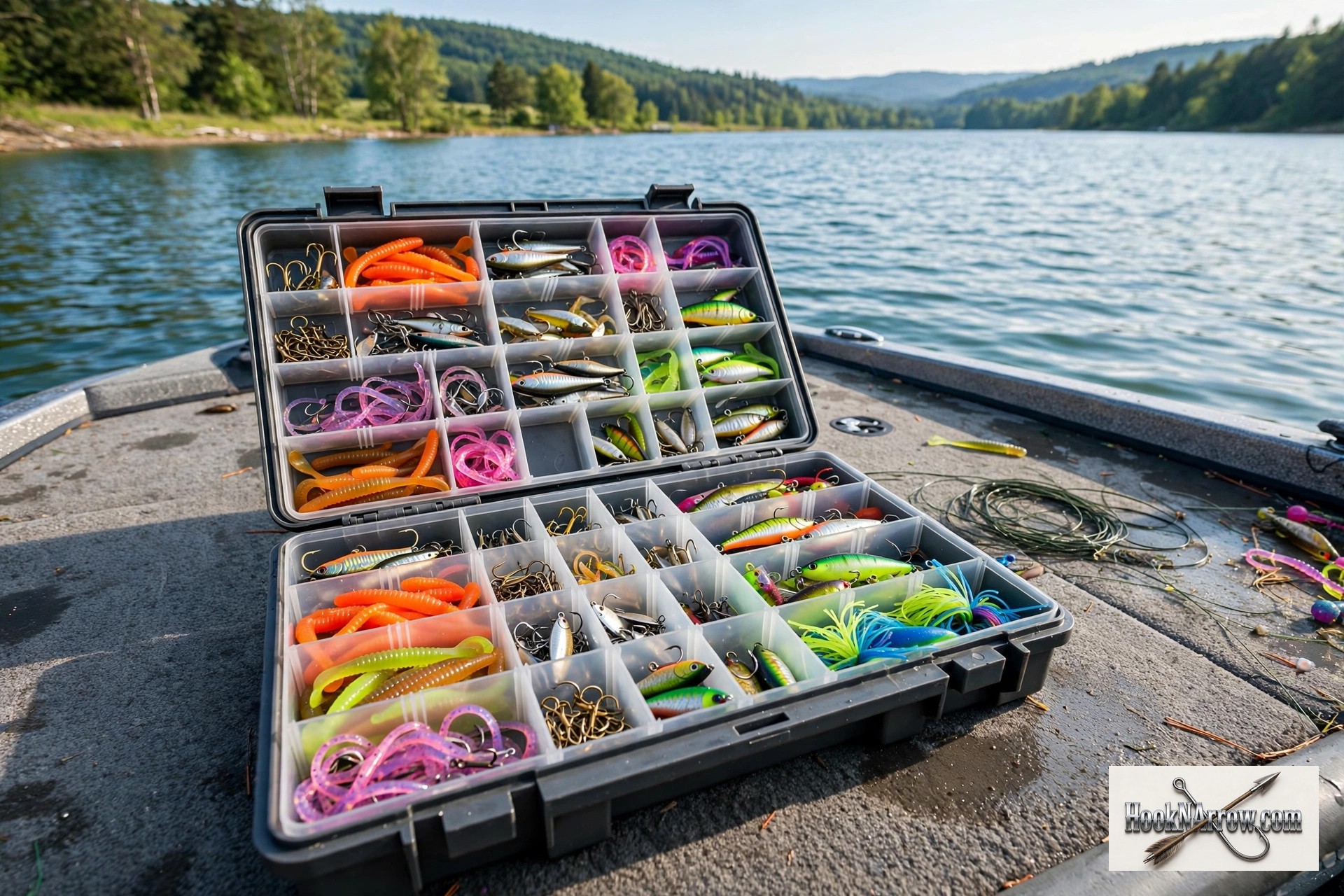
Every Texas angler has a tackle storage origin story, and it usually involves a cheap box, a July afternoon, and a lid that now warps like a potato chip. Texas heat is the great destroyer of tackle storage: thin plastic softens and stops latching, hooks rust in the humidity, and a box that isn’t waterproof becomes tackle soup after one rainstorm on the boat deck at Sam Rayburn.
As an Amazon Associate I earn from qualifying purchases.
Good tackle storage isn’t glamorous, but it’s the difference between grabbing the right crankbait in ten seconds and digging through a tangled graveyard while schooling fish blow up 40 yards away. This guide covers what actually matters — box sizing, waterproofing, heat resistance, and organizing for the way Texas anglers really fish.
What to Look For
The 3700 standard. Most modern tackle storage is built around the 3700-size utility box — roughly 14 by 9 inches. Boat compartments, tackle bags, and kayak crates are all designed to hold them. Standardize on the 3700 footprint and everything you own stays interchangeable: the box that lived in your bass boat fits your bank-fishing bag and your kayak crate.
Latch quality. This separates a box that lasts five years from one that lasts five months. Look for latches that close with a positive snap and stay closed when the box bounces in a rod locker. In a boat, a box that pops open in the compartment is a disaster — a hundred hooks loose in the bilge is a special kind of misery.
Waterproofing. “Water-resistant” and “waterproof” are not the same thing. A box with a rubber gasket around the lid keeps rain, splash, and dunkings out; a box without one keeps nothing out. For saltwater trips to the coast, waterproofing isn’t optional — salt air rusts hooks fast, and a sealed box buys you real time.
Heat resistance. Texas summer warps thin, cheap plastic. Thicker-walled boxes with rigid lids hold their shape; flimsy boxes bow, and once the lid bows, the seal is gone and the latches stop catching. If a box feels flimsy in air conditioning, imagine it after six hours on a boat deck in August. This is the number one reason to spend a little more on tackle storage in Texas.
Dividers and adjustability. Fixed compartments are fine for terminal tackle; adjustable dividers are essential for hard baits, because crankbaits and topwaters come in every size and you need compartments that fit. Look for boxes where dividers lock in securely — dividers that slide around under their own weight let hooks migrate between compartments, which defeats the purpose.
Soft vs. hard storage. Hard boxes protect baits and stack neatly; soft tackle bags carry multiple hard boxes plus pliers, line, sunscreen, and rain gear in one grab-and-go package. Most serious Texas anglers run both: hard 3700 boxes as the system, and a soft bag or backpack to carry them for bank fishing, kayak fishing, or as a boat-deck organizer. Neither replaces the other.
Rust prevention. Texas humidity rusts hooks — freshwater humidity in East Texas, salt air on the coast. Some boxes come with rust-inhibiting dividers (Flambeau’s Zerust system is the known name). The dividers emit a vapor that forms a protective layer on metal. It’s not magic — you still shouldn’t store wet baits — but it meaningfully extends hook life.
The Picks
Plano 3700-Series StowAway — the standard everything fits
Who it’s for: Everyone. If you’re building a tackle system from scratch, this is box number one — the baseline that every bag, boat compartment, and kayak crate is designed around.
Pros: The 3700 footprint is the industry standard, so these fit everywhere; clear lids let you see what’s inside; adjustable dividers; inexpensive enough to buy a half-dozen and organize by technique; the ProLatch versions close with a secure snap.
Cons: Not waterproof — no gasket, so rain and dunkings get in; the standard plastic can bow in brutal Texas heat on a dark boat deck; dividers can shift if you don’t seat them firmly.
Plano Edge 3700 Series — the upgrade
Who it’s for: The angler who’s tired of replacing warped boxes and rusted hooks — anyone running a bass boat in Texas who wants their storage to match the investment in the baits inside.
Pros: Thicker, more rigid construction that stands up to Texas heat far better than basic boxes; the waterproof 3700 has a gasket seal; one-hand latch operation; purpose-built boxes (jig, crankbait, terminal tackle) let you organize by technique instead of cramming.
Cons: Two to three times the price of a basic StowAway — outfitting a whole boat adds up; heavier than basic boxes, which matters if you’re carrying a loaded bag far. Worth it for boat storage; maybe overkill for a bank-fishing kit.
Purchase this item on Amazon →
Flambeau Zerust Max / Tuff Tainer — the rust fighter
Who it’s for: Coastal anglers, anyone fishing salt or brackish water, and freshwater anglers in humid East Texas who are tired of opening a box to find orange hooks.
Pros: The Zerust dividers genuinely inhibit rust — the standout feature, and well proven; sturdy boxes with good latches; the Zerust Max series adds a gasket for water resistance; especially valuable for expensive hard baits and saltwater tackle.
Cons: The Zerust protection fades over a few years and doesn’t replace drying your tackle; not quite at the Plano Edge level for heat rigidity; availability of specific sizes can be spotty.
Purchase this item on Amazon →
Bass Mafia Bait Coffin 3700 — the tank
Who it’s for: Tournament anglers and heavy-use fishermen who destroy normal boxes — the guy whose tackle lives in the boat year-round and gets fished 100+ days a year.
Pros: Absurdly tough — thicker walls, stronger latches, gasket seal; built to be the last box you buy for that slot; the most positive-closing latches in the business.
Cons: The heaviest 3700 boxes you’ll find; the most expensive utility boxes on this list by a wide margin; overkill for casual anglers — if you fish a dozen times a year, a Plano Edge does the job for less.
SpiderWire Tackle Bag / Tackle Backpack — the carry system
Who it’s for: Bank anglers, kayak anglers, pond hoppers, and anyone who needs to carry a full system to the water instead of fishing out of a boat.
Pros: Holds multiple 3700 boxes plus tools, line, and gear in one organized package; backpack versions free your hands for rods on a long walk to a Hill Country creek; easier than juggling loose boxes; good bags have plier holders, sunglass pockets, and rain covers.
Cons: A loaded tackle backpack is heavy — be honest about how far you’re walking; soft bags offer less crush protection than hard boxes; zippers are the failure point — rinse them after saltwater use. Buy the bag to fit the boxes you own, not the other way around.
Pelican Case (1150 / 1200 size) — for the irreplaceable stuff
Who it’s for: Protecting valuables: prescription sunglasses, phone, wallet, and keys on the boat; also excellent for camera gear, and for a small “survival kit” of terminal tackle on a kayak.
Pros: The waterproof, crushproof standard — a gasketed Pelican keeps your phone dry if the boat takes a wave over the bow or the kayak flips; the pressure-equalization valve handles Texas heat expansion; essentially indestructible.
Cons: Expensive for a small dry box — don’t buy one to store crankbaits; heavy and bulky for the interior volume; the latches are stiff by design. This is insurance for valuables, not general tackle storage.
Purchase this item on Amazon →
Practical Tips for Texas
Organize by technique, not by color. One box for crankbaits, one for terminal tackle, one for topwater, one for soft plastics. When the bite changes at noon on Rayburn, you grab one box, not six. Label the box ends with a paint pen so you can read them stacked in a compartment.
Keep soft plastics in their bags. Loose soft plastics melt together in Texas heat and react with hard-bait paint. Keep them in their original bags, stored flat.
Dry everything before it goes back in the box. The number one cause of rusted hooks isn’t the lake — it’s putting wet baits back in a sealed box, where trapped moisture goes to work. After a rainy day or a saltwater trip, open the boxes at home and let everything air-dry.
Don’t leave loaded boxes on a dark boat deck in August. Even good boxes have limits. A dark box in direct Texas sun gets hot enough to soften plastic and melt soft baits. Store boxes in compartments and bring the bag inside between trips.
Kayak anglers: think vertical and secured. Kayak tackle lives behind the seat getting splashed and bounced. Use gasketed 3700 boxes, strap the crate down, and keep a small waterproof box up front for the baits you’re actually throwing.
Saltwater trips need a separate system. Keep a dedicated saltwater box or two. Salt gets into everything, and a box that goes back and forth will eventually salt your freshwater hooks. Rinse saltwater boxes with fresh water after every trip.
FAQ
What size tackle box should I buy? Start with the 3700 size (about 14 x 9 inches). It’s the standard that fits boat compartments, tackle bags, and kayak crates. Buy several and organize by technique. Smaller 3600 boxes work for terminal tackle and fit in bags; avoid random sizes that fit nothing you own.
Are waterproof tackle boxes worth the extra money in Texas? Yes, for boat storage. Afternoon thunderstorms, livewell splash, and morning dew are constant, and a gasketed box is the difference between dry hooks and rust. For bank fishing in a bag that comes home with you, standard boxes are fine — but the price gap has narrowed enough that waterproof is worth it wherever tackle lives in the boat.
How do I stop hooks from rusting in the humidity? Four things: dry baits before they go back in the box, use boxes with rust-inhibiting dividers (like the Flambeau Zerust line), don’t store wet tackle in sealed boxes, and for saltwater, rinse with fresh water after every trip. No single trick replaces all four.
Will Texas heat really warp a tackle box? Yes — it’s the most common tackle storage failure in the state. Thin plastic lids bow in sustained heat, and once the lid bows the seal fails and the latches stop catching. Thicker-walled boxes (Plano Edge, Bass Mafia) resist it far better. Storing boxes out of direct sun and bringing the bag inside between trips extends the life of any box.
Keep Reading: More Buying Guides
More Hunting Gear Guides
- Best Trail Cameras for Whitetail Deer 2026
- Best Hunting Knives for Deer & Hog Hunting (2026)
- Best Deer Hunting Scopes 2026
- Best Binoculars for Hunting 2026
- Best Thermal Scopes for Hog & Predator Hunting (2026 Guide)
- Best Bear Hunting Gear 2026
- Best Elk Hunting Gear 2026
- Best Mountain Lion Hunting Gear 2026
Leave a Reply