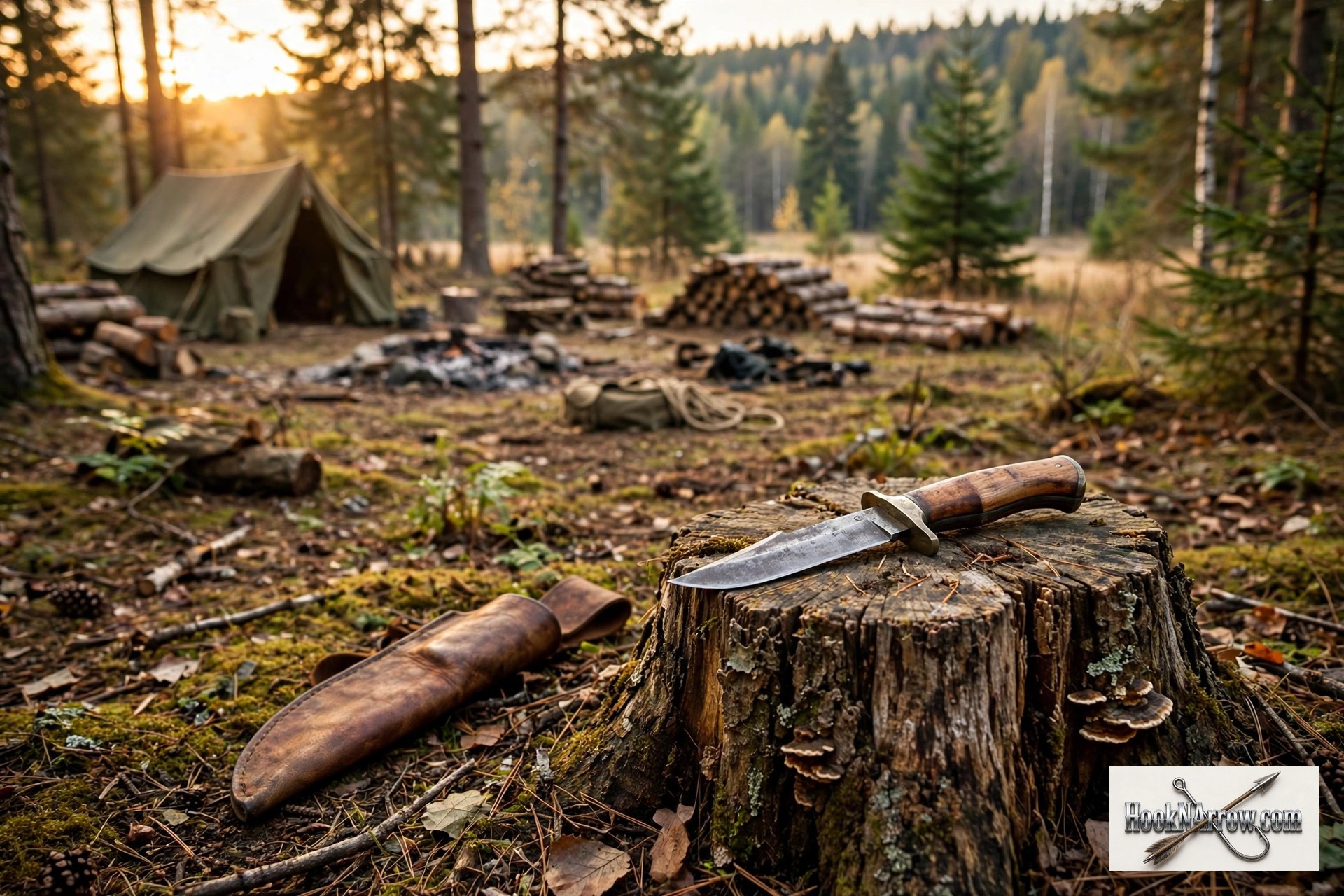
Here’s a Texas truth: you will field dress a whitetail in the dark, in the rain, with blood-slick hands, while mosquitoes eat you alive. Maybe it’ll be a 200-pound boar in South Texas brush at noon in September. Either way, the knife in your hand matters a lot more than the knife in the catalog.
As an Amazon Associate I earn from qualifying purchases.
Texas hunting asks specific things of a knife. Whitetail are thin-skinned and easy to open, but hogs are a different animal — a big boar has a thick cartilage shield over its shoulders that will roll the edge on a cheap blade. You’ll also use the same knife for camp chores: cutting rope, opening feed sacks, maybe whittling a tent stake.
The big fork in the road: a traditional fixed blade you sharpen, or a replaceable-blade knife that stays scalpel-sharp because you swap blades. Both are legitimate. We’ll cover both, plus a couple of classics.
What to Look For
Fixed blade vs. replaceable blade vs. folder. A fixed blade is the strongest and simplest — one piece of steel, no moving parts, easy to clean. A replaceable-blade knife (like a Havalon or Outdoor Edge) uses disposable scalpel blades: it’s always razor sharp, but the blades are thin and can snap if you pry with them, and changing a bloody blade in the field takes care. A folding hunter is compact and pocket-friendly, but the pivot is a place for blood and guts to hide, so cleaning takes more work.
Blade steel: stainless vs. carbon, in plain language. Stainless steel resists rust — a real advantage in Texas humidity and when you’re washing blood off a blade at camp. The tradeoff is that most stainless is a little harder to sharpen. Carbon steel takes a keener edge and sharpens easily, but it will rust if you look at it wrong in East Texas humidity. For most Texas hunters, stainless is the practical choice.
Blade length. For deer and hogs, 3.5 to 5 inches is the sweet spot. Shorter gives you control inside the body cavity; longer helps with skinning strokes. Anything over 5 inches is a camp knife, not a gutting knife. A 4-inch blade does everything.
Handle grip when bloody. Smooth wood or polished handles get slippery. Look for textured rubber, Micarta, or checkered handles that stay grippy when wet. A guard or flared pommel that keeps your hand from sliding onto the blade is worth more than a pretty handle.
Sheath. A bad sheath will lose your knife in the brush or let the blade cut through into your leg. Kydex sheaths are light, secure, and wash clean. Leather is classic and quiet but holds moisture. Make sure it has positive retention — the knife should click in and not fall out upside down.
Our Picks
Morakniv Companion — best budget fixed blade, full stop
Who it’s for: Every hunter who needs a knife that just works, especially if you’re buying your first real field knife.
The Mora Companion is the most knife per dollar in the outdoor world. The stainless version shrugs off Texas humidity, the rubberized handle grips like it was designed for bloody hands, and it comes scary sharp out of the box. It’s not fancy, but it will field dress deer after deer.
Pros: Extremely affordable; excellent grip in wet conditions; stainless blade resists rust; light enough to forget it’s on your belt.
Cons: The blade is on the thinner side — don’t pry with it; the basic sheath is functional, not premium; no finger guard to speak of, so mind your grip on a big hog.
Purchase this item on Amazon →
Outdoor Edge RazorPro — best replaceable-blade knife
Who it’s for: The hunter who hates sharpening and wants a fresh scalpel edge on every animal.
The RazorPro carries replaceable blades that swap out in seconds — when one dulls on a hog’s shield, you click in a new one and keep going. For a guy who processes several deer and hogs a season and never wants to sit at a whetstone, this is the answer.
Pros: Always razor sharp — just swap the blade; blade changes are quick and tool-free; the rubberized handle is secure when bloody; great for hunters who process a lot of animals.
Cons: Replacement blades are an ongoing cost; thin blades can snap if you twist or pry — it’s a slicer, not a lever; changing blades with bloody hands takes practice and care.
Purchase this item on Amazon →
Havalon Piranta — best ultralight replaceable blade
Who it’s for: The minimalist who wants the lightest capable knife in the pack.
The Piranta weighs almost nothing, folds into a pocket clip, and the scalpel blades are surgically sharp — caping and detail skinning work is where it shines. A lot of hunters pair it with a sturdier fixed blade: the fixed blade opens the animal, the Piranta does the fine work.
Pros: Featherweight and pocketable; insanely sharp replaceable blades; excellent for caping and detail work; cheap enough to keep as a second knife.
Cons: Too light-duty to be your only knife on a big boar; blades are delicate — snap risk if forced; the handle is small for big gloved hands.
Purchase this item on Amazon →
Buck 119 Special — best classic fixed blade
Who it’s for: The traditionalist who wants one knife to last a lifetime.
The 119 Special has been around since the 1940s and it’s still one of the best all-around hunting knives made. The clip-point blade is the right shape for both gutting and skinning, Buck’s 420HC stainless holds an edge well and sharpens easily, and the handle with the aluminum guard is secure and classic. Buck’s forever warranty is real.
Pros: Proven design refined over 80 years; good stainless steel that’s easy to maintain; comfortable, secure handle with a real guard; Buck’s lifetime warranty.
Cons: Heavier than modern skeletonized knives; the leather sheath is classic but needs care in humidity — consider upgrading to Kydex if you’re in the Piney Woods; not the cheapest option here.
Purchase this item on Amazon →
Buck 110 Folding Hunter — best folding hunter
Who it’s for: The hunter who wants a pocket knife that can handle a deer in a pinch.
The 110 is the most famous folding hunter ever made, and it earned it. The lockback is rock solid, the blade is full-sized at 3.75 inches, and it rides in a belt sheath or a pocket. As a primary field-dressing knife a fixed blade is better, but the 110 is the folder that comes closest.
Pros: Legendary lockup strength for a folder; full-size blade handles real work; beautiful and built to last generations; Buck’s lifetime warranty.
Cons: The pivot collects blood and needs thorough cleaning; heavier than modern folders; brass and wood need more care in wet conditions than synthetic handles.
Purchase this item on Amazon →
Gerber StrongArm — best tough camp-and-field knife
Who it’s for: The hunter who wants one knife that dresses deer, splits kindling, and survives abuse.
The StrongArm is a full-tang fixed blade built like a tank: a 4.8-inch 420HC stainless blade, textured rubber grip that stays put when wet, and a MOLLE-compatible sheath. It’s overbuilt for gutting a doe, which is exactly the point — it’ll also baton firewood, cut shooting lanes, and do every camp chore without complaint.
Pros: Full tang — extremely strong; grippy handle in all conditions; versatile enough for camp chores beyond field dressing; good value for the toughness.
Cons: On the big side for delicate skinning work; the tanto-style tip options are less ideal for gutting — get the drop point or serrated version thoughtfully; heavier than a dedicated gutting knife.
Purchase this item on Amazon →
ESEE Izula — best small fixed blade
Who it’s for: The hunter who likes a compact, bombproof neck or belt knife.
The Izula is a small skeletonized fixed blade — under 3 inches of 1095 carbon steel — that’s become a cult favorite. It’s tiny enough to wear all day and forget, tough enough to trust, and the 1095 carbon takes a wicked edge. The catch for Texas: 1095 is carbon steel, not stainless, so it needs oil and attention in our humidity. Keep it maintained and it’s a fantastic little knife; neglect it and it’ll spot with rust.
Pros: Tiny, light, and nearly indestructible; 1095 carbon gets extremely sharp; ESEE’s no-questions-asked warranty is legendary.
Cons: Carbon steel needs oil in Texas humidity; the skeleton handle wants aftermarket scales for comfort on a long skinning job; short blade isn’t ideal as your only knife on a big hog.
Purchase this item on Amazon →
Texas Tips That Actually Matter
Hogs dull knives faster than deer. A boar’s shoulder shield is basically armor. If you hunt hogs regularly, either carry a replaceable-blade knife or touch up your edge before every hog.
Carry a small sharpener. A little diamond rod in your pack weighs nothing and saves a hunt. Five strokes per side at the truck before you walk in beats struggling with a rolled edge in the field.
Wash and dry your knife at camp, every time. Blood is corrosive, and Texas humidity finishes the job. Rinse the blade, dry it, wipe the handle. Thirty seconds at the skinning rack adds years to a knife’s life.
Gut from the sternum, not the throat. On Texas whitetail, you rarely need to open the chest fully in the field. A cut from sternum to pelvis, careful around the diaphragm, gets the job done with less mess. Save the chest opening for the skinning rack.
Keep the knife on your body, not in the pack. When you walk up on a downed animal, the knife needs to be on your belt or in your pocket — not twenty yards back in your pack.
In the Piney Woods, go stainless. East Texas humidity plus blood plus a leather sheath is a rust recipe. Stainless blades and Kydex sheaths will save you grief.
FAQ
Fixed blade or replaceable blade — which should I buy first? A fixed blade. It’s stronger, simpler, and does everything adequately. Add a replaceable-blade knife later as a second knife for detail work or as your dedicated hog knife.
What blade length is best for field dressing a whitetail? Three and a half to four and a half inches. Shorter gives you control working inside the body cavity without nicking the gut. Longer blades are for skinning strokes and camp work, not for the initial opening.
Is carbon steel okay in Texas humidity? It works, but it’s high maintenance. Carbon takes a keener edge, but it will rust in a humid deer camp if you don’t oil it. If your knife sits bloody in the truck until morning, buy stainless.
Do I need a separate skinning knife? Not to start. A 4-inch drop-point fixed blade skins just fine — use long, smooth strokes and let the edge do the work. A dedicated skinning knife is a nice upgrade later if you process a lot of animals.
Keep Reading: More Buying Guides
More Hunting Gear Guides
- Best Trail Cameras for Whitetail Deer 2026
- Best Deer Hunting Scopes 2026
- Best Binoculars for Hunting 2026
- Best Thermal Scopes for Hog & Predator Hunting (2026 Guide)
- Best Bear Hunting Gear 2026
- Best Elk Hunting Gear 2026
- Best Mountain Lion Hunting Gear 2026
Leave a Reply