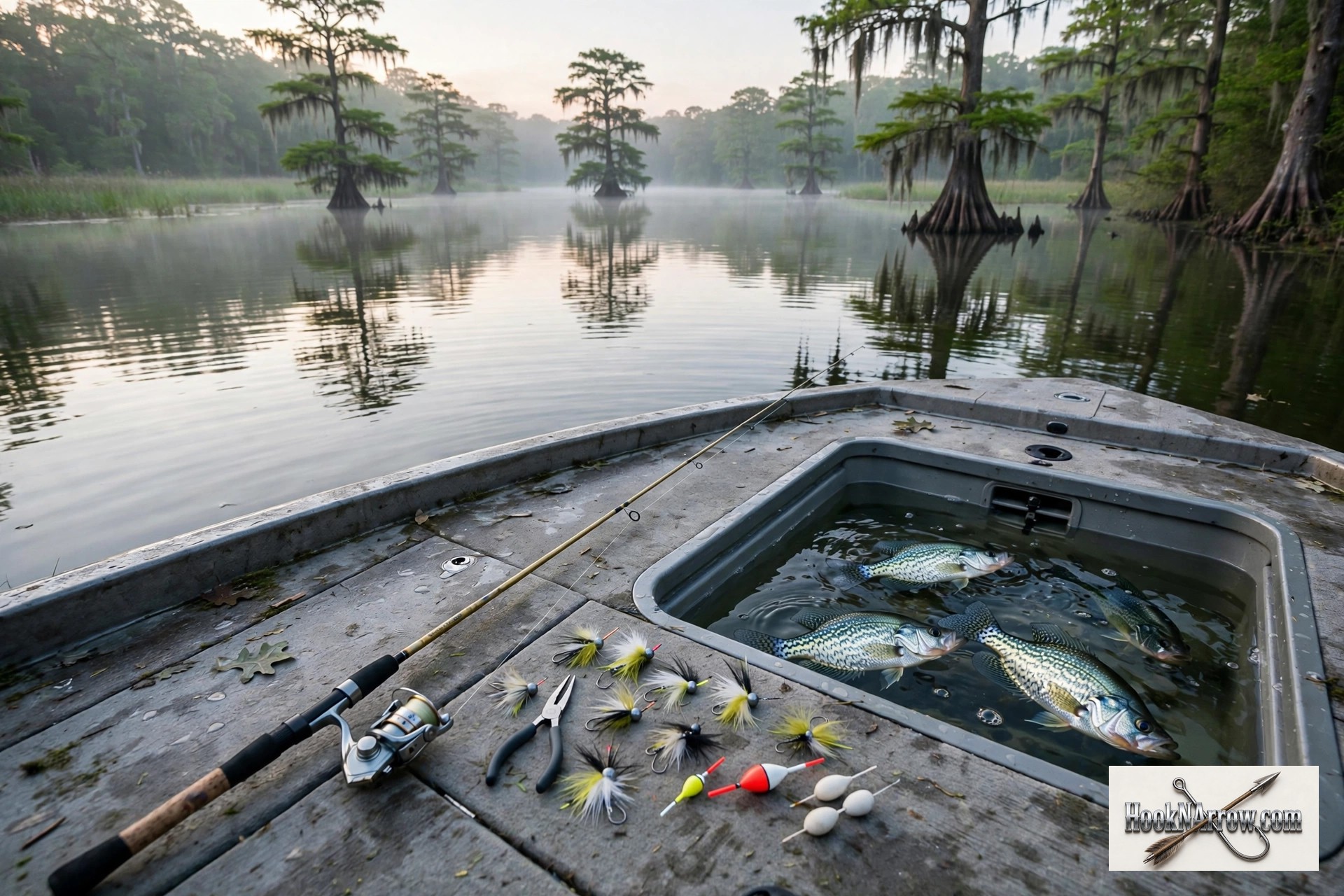
If you grew up in Texas, you didn’t call them crappie — you called them white perch, and you learned early that a spring fish fry with a cooler full of slabs is about as good as life gets. Texas has some of the finest crappie water in the country: Lake Fork, Toledo Bend, Sam Rayburn, Lake Tawakoni, Richland-Chambers. These lakes grow thick-shouldered slabs, and every spring the creeks fill with spawning fish while the boat ramps fill with folks chasing them.
As an Amazon Associate I earn from qualifying purchases.
Crappie fishing isn’t one technique, though — it’s about five. Spider rigging a spread of long poles off the front of the boat, vertical jigging a brush pile, shooting jigs back under boat docks, tight-lining minnows over standing timber, or just bobber-fishing a creek channel in March. Each one wants different gear, and showing up with the wrong rod is how you spend the day frustrated instead of catching.
This guide covers the whole setup Texas crappie anglers actually use: long poles, dock shooters, small spinning reels, line, jigs and soft plastics, minnow rigs, and landing nets. No fluff — just what works on Fork, Rayburn, Toledo Bend, Tawakoni, Conroe, and Lavon, including how to stay on fish when the August sun turns the lake into a frying pan.
What to Look For in Crappie Gear
Rod length and action. This is the big decision. For spider rigging and vertical jigging, you want long poles — 10 to 16 feet — with a soft, sensitive tip so you can see the lightest bite, and enough backbone down low to swing a slab into the boat. For dock shooting, you want the opposite: a short, stout 5- to 6-foot rod with a fast tip you can load up like a bow to skip a jig twenty feet back under a dock. A good 6- to 7-foot light-action spinning rod splits the difference for casting jigs and fishing minnows under a bobber.
Reels. Small spinning reels in the 1000 to 2000 size range are the standard. You don’t need big line capacity — crappie don’t make long runs — but you do need a smooth drag, because light line and a paper-thin crappie mouth will punish a jerky drag. It should balance on a light rod without feeling like a brick.
Line. For jigging, 4- to 6-pound monofilament is the Texas standard — a little stretch is forgiving on light bites and thin mouths. High-visibility yellow or chartreuse line is worth its weight in gold: crappie often hit on the fall, and you’ll see the line jump or go slack before you ever feel a thing. For spider rigging deep water, some anglers switch to braid for better feel. For minnows under a bobber, plain 6-pound mono does fine.
Jigs and weights. The workhorse sizes are 1/32, 1/16, and 1/8 ounce. Go lighter when fish are shallow and finicky in spring; go heavier fishing twenty feet down over a Rayburn brush pile or in a spring wind on Toledo Bend. Keep chartreuse, pink, orange, and black/chartreuse combos for the stained water most Texas lakes run, plus shad and minnow patterns for clear-water days on Fork.
Live bait rigs. Minnows are the Texas staple — a #2 or #4 Aberdeen hook (the long shank makes unhooking easy), a split shot or two, and a slip bobber you can slide to any depth. Simple, cheap, and it catches crappie everywhere from Lake Lavon to Choke Canyon.
Landing nets. Get a rubber-coated net with a telescoping handle. Rubber doesn’t tangle hooks or tear up a fish’s slime coat like knotted nylon does, and a long handle matters when you’re swinging a slab up from the end of a 12-foot pole.
The Picks
1. B’n’M Sam Heaton Super Sensitive — Best Long Pole for Jigging and Spider Rigging
Who it’s for: The angler who wants to fish the way the tournament guys do — vertical jigging brush piles and spider rigging multiple long poles over deep timber on Rayburn or Toledo Bend.
PROS: B’n’M built its whole reputation on crappie poles, and the Super Sensitive line is the reason why: a tip soft enough to telegraph a light bite at twenty feet, light enough that holding it all morning doesn’t wear you out, and plenty of backbone down low to boat a two-pound slab. Check the manufacturer’s specs for current length options.
CONS: A 12-foot pole is a handful in a small boat, and the long, thin tip that makes it sensitive is also the part that breaks if you slam it in a rod locker. This is a specialist tool, not a cast-and-retrieve rod.
2. ACC Crappie Stix Dock Shooting Rod — Best Dock Shooter
Who it’s for: Anyone fishing lakes full of boat docks and marinas — Lake Conroe, Fork, the developed arms of Rayburn — who wants to skip a jig way back into the shade where the big slabs live.
PROS: ACC Crappie Stix has become the name in this niche for a reason. The blank loads up like a bow when you pinch the jig and pull back, then launches it on a flat skip under the dock. Stiff enough to set the hook at the end of a long skip, and short enough for tight quarters.
CONS: It does exactly one thing. You won’t be casting across a flat or spider rigging with it. If you don’t fish docks, skip it.
Purchase this item on Amazon →
3. Jenko Fishing Crappie Rod — Best All-Around Spinning Rod
Who it’s for: The bank angler, the dock fisherman, or anyone who wants one rod that handles jigs, minnows under a bobber, and the occasional cast to schooling fish.
PROS: Jenko is a crappie-focused company, and their mid-length spinning rods hit the sweet spot: a light tip for casting 1/16-ounce jigs, enough backbone to handle a surprise bass or catfish, and a comfortable handle for a long morning on a Lavon fishing pier.
CONS: Jack of all trades, master of none. It won’t out-jig a 12-foot pole on a brush pile or out-shoot a dedicated dock rod under a marina.
4. Pflueger President Spinning Reel (Size 20) — Best Reel for the Money
Who it’s for: Everybody. If you’re spooling up a crappie rod and want a reel that just works, this is the default answer.
PROS: Smooth drag for its class, which is what matters with 4-pound line and thin crappie mouths. The size 20 holds plenty of light line, it’s light enough to balance a 6- or 7-foot rod, and Pflueger has been making this reel for years.
CONS: It’s not a sealed reel, so rinse it after a dusty boat ride and don’t dunk it. It’s strictly freshwater — don’t take it on a Galveston Bay trip and expect it to survive.
Purchase this item on Amazon →
5. Bobby Garland Baby Shad — Best Soft Plastic
Who it’s for: The jig fisherman. If you cast or shoot jigs for crappie, you need a box of these.
PROS: The 2-inch Baby Shad is about as close to a can’t-miss crappie bait as exists — a shad profile with a thin, quivering tail that moves on the fall. It comes in every color Texas crappie want, from electric chicken (chartreuse and pink) for stained water to shad patterns for clear Fork days, and it rigs perfectly on a 1/16-ounce head.
CONS: That thin tail is also its weakness — short-striking fish tear it up, so buy more than you think you need. And it won’t out-fish a live minnow on the toughest days.
Purchase this item on Amazon →
6. Strike King Mr. Crappie Jig Heads — Best Jig Heads
Who it’s for: Anyone tying on a soft plastic, which should be everyone reading this.
PROS: Sharp hooks, clean paint jobs in the colors that matter, and the weights (1/32, 1/16, and 1/8 ounce) cover everything from spring shallows to summer brush piles. They pair perfectly with the Baby Shad above — 1/16 ounce is the everyday Texas size.
CONS: Painted heads chip on rocks and dock pilings, so buy the multi-packs. And match the hook size to your plastic — a big gap on a tiny bait fishes worse.
Tips: Catching Texas Crappie
Fish the spawn. February through April, crappie push up the creeks — the Sabine arm of Toledo Bend, the creeks off Fork and Rayburn, the upper ends of Tawakoni and Lavon. Fish shallow cover with a minnow under a bobber or a 1/32-ounce jig, and go on weekdays if you can — spring weekends at the ramp are a contact sport.
Go deep in summer. When the surface temp pushes 90 on Conroe or Amistad, crappie slide out to brush piles and standing timber in 15 to 25 feet. This is spider-rigging and vertical-jigging season. Launch at daylight, plan to be off the water by early afternoon, and drink more water than you think you need.
Keep minnows alive. Minnows are the Texas staple, but a dead minnow catches nothing. Keep the bucket shaded, keep an aerator running, and change the water if it gets hot. In August, a bait bucket in the sun is a minnow graveyard within the hour.
Watch the line, not the rod. With hi-vis line, most crappie bites show up as the line jumping, twitching, or going slack — especially on the fall. If you wait until you feel it, you’ve missed it.
Learn to shoot docks. On lakes like Conroe and Fork, the biggest slabs live where most people can’t cast — deep in the shade under boat docks. A dock-shooting rod and a 1/16-ounce jig put you on fish other anglers motor right past.
FAQ
What pound test line should I use for crappie? Four- to six-pound monofilament covers just about everything in Texas. Go lighter (4 lb) when fish are finicky in clear water; 6 lb gives you a little insurance around brush and dock cables.
Can I get by with one crappie rod? Absolutely. A 6- to 7-foot light-action spinning rod with a small reel handles jigs, minnows under a bobber, and bank or dock fishing. The long poles and dock shooters are for when you want to specialize.
Are live minnows really better than jigs? On tough days, yes — minnows are the Texas staple for a reason. But jigs catch plenty of fish, they’re cheaper over a season, and you don’t have to keep anything alive. Most serious crappie anglers carry both and let the fish decide.
When do crappie spawn in Texas? Generally February through April, moving shallower as water temps climb through the 60s. The creeks and upper lake arms warm first, so start your spring there.
Do I need a boat to catch Texas crappie? No. Bank fishing, piers, bridges, and marina docks all produce — especially in spring when fish are shallow. A boat just lets you reach the deep summer brush piles and spider-rig the timber.
Keep Reading: More Buying Guides
More Hunting Gear Guides
- Best Trail Cameras for Whitetail Deer 2026
- Best Hunting Knives for Deer & Hog Hunting (2026)
- Best Deer Hunting Scopes 2026
- Best Binoculars for Hunting 2026
- Best Thermal Scopes for Hog & Predator Hunting (2026 Guide)
- Best Bear Hunting Gear 2026
- Best Elk Hunting Gear 2026
- Best Mountain Lion Hunting Gear 2026
Leave a Reply