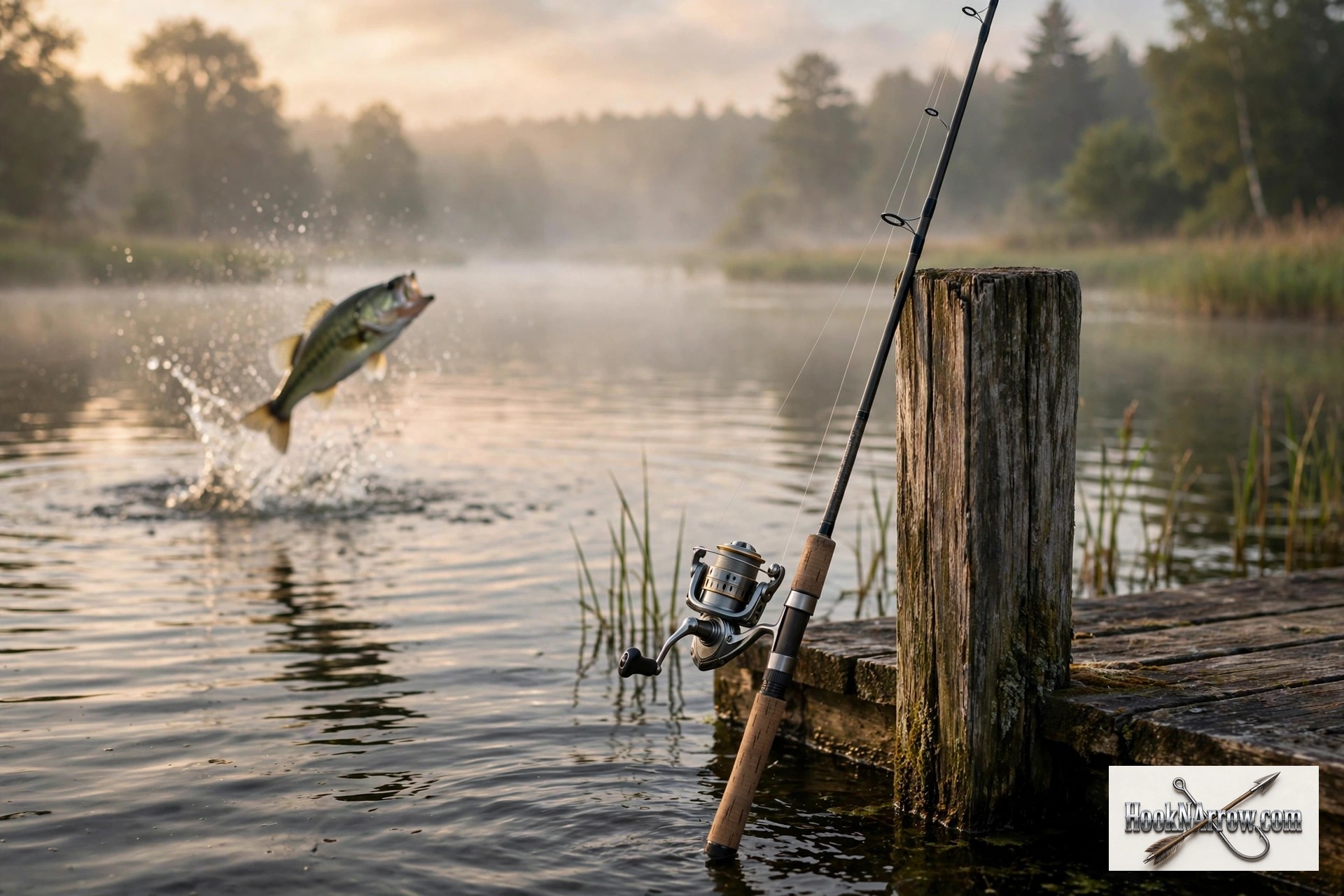
Texas bass fishing is not like bass fishing anywhere else. A morning flipping flooded timber at Lake Fork, an afternoon burning a crankbait over the humps at Toledo Bend, and an evening shaking a dropshot in the clear Hill Country water of Canyon Lake — that’s three completely different games, and the rod you hold in your hand has to match the game you’re playing.
As an Amazon Associate I earn from qualifying purchases.
Texas lakes are big, the cover is heavy, and the fish are big. A bass that weighs eight pounds at Lake Fork is not unusual, and when she buries herself in hydrilla or a flooded buck brush thicket, you don’t horse her out with a soft stick. Our lakes run deep too — Sam Rayburn, Toledo Bend, and Texoma all have ledges and humps in 15 to 30 feet of water where a long-casting crankbait rod with real backbone earns its keep. Then there’s the brutal summer heat, when the only bite window might be a shad spawn at first light or a finesse bite in clear water on a lake like Stillhouse or Belton.
This guide covers what to look for in a bass rod and five proven rods that handle real Texas scenarios, from flipping heavy cover at Fork to launching crankbaits across Toledo Bend to fishing clear Hill Country lakes. No hype, no invented specs — just what works and why.
What to Look For
Before you pick a rod, learn the language. Two terms matter most:
Power is how strong the rod is — how much pressure it takes to bend it. Ratings run ultra-light through medium, medium-heavy, heavy, and extra-heavy. For Texas bass, medium-heavy (MH) is the workhorse power: enough backbone to pull a fish out of grass and enough tip to fish a Texas rig, a jig, or a spinnerbait. Heavy (H) is your flipping and frogging stick for dense cover. Medium (M) fits crankbaits and topwaters where the rod’s flex absorbs the strike instead of pulling hooks out.
Action is where the rod bends. Fast action bends mostly in the top third of the blank — quick hooksets, sensitive, good for jigs and Texas rigs. Moderate-fast and moderate actions bend deeper into the blank — they keep treble hooks pinned on crankbaits and topwater plugs because the rod gives instead of ripping the hooks free. Slow action is mostly a specialty thing in bass fishing.
Other things that matter:
- Length. Around 7 feet is the standard all-arounder. Longer rods (7’3″ to 7’11”) cast farther and pick up more line on the hookset — good for deep cranking and flipping. Shorter rods (6’6″ to 6’10”) are more accurate for skipping docks and working tight cover.
- Blank material. Most bass rods are graphite (also called carbon). Higher-modulus graphite is lighter and more sensitive but stiffer and pricier. Lower-modulus and fiberglass blends flex more, which is why many crankbait rods still use composite or glass blanks — they forgive a surging fish.
- Guides. Quality guides keep line flowing and reduce tangles. On a budget rod, check that guides are aligned and feel smooth. Stainless or ceramic inserts are standard at reasonable prices now.
- Handle. A full cork or EVA handle is personal preference, but in a Texas August you’ll appreciate a grip that doesn’t get slippery when your hands sweat. Split grips cut weight; full grips give you more to grab on a hookset.
Our Picks
St. Croix Mojo Bass — best all-around Texas workhorse
The Mojo Bass is the rod you’ll see on more Texas boat decks than almost anything else. St. Croix builds it on a mid-modulus graphite blank that’s sensitive enough to feel a jig bite in deep brush piles at Sam Rayburn and tough enough to survive being bounced around a bass boat in the Piney Woods summer.
Who it’s for: The angler who wants one or two rods that cover 80 percent of Texas bass fishing — Texas rigs, jigs, spinnerbaits, frogs.
Pros: Excellent sensitivity for the price; the 7’1″ MH fast-action model is about as versatile a Texas bass rod as exists; durable Fuji-style guides and a comfortable reel seat; St. Croix’s warranty support has a strong reputation.
Cons: At the upper end of a mid-range budget; the action runs a touch fast on some models, so it’s not the pick for crankbaits; the power ratings feel slightly stout, so size down if you fish a lot of light line in clear water.
Purchase this item on Amazon →
Dobyns Fury 734C — best Texas rig and jig rod
Gary Dobyns designed his rods for California delta fishing, but the Fury series might as well have been designed for Lake Fork. The 734C (7’3″, heavy power, fast action) is the quintessential Texas flipping, pitching, and heavy jig stick. The extra length gives you leverage over flooded timber, and the fast tip snaps hooks home before a Fork giant can turn into the brush.
Who it’s for: Flipping, pitching, heavy Texas rigs, and jigs in thick cover — the Fork and Toledo Bend playbook.
Pros: Purpose-built heavy-cover actions; great balance for a 7’3″ rod, so it doesn’t wear you out pitching all day; very fair pricing for a rod that fishes above its price point; Dobyns’ reputation for standing behind their blanks.
Cons: Not versatile — the 734C is a specialty tool, and you’ll want other rods for crankbaits and finesse; limited availability in some big-box stores compared to the biggest brands; handle aesthetics are plain, if you care about that.
Shimano SLX — best budget rod
The SLX rod line brought Shimano’s rod quality down to a price that lets a young angler outfit a whole boat. Pair the SLX rod with an SLX reel and you’ve got a Texas-ready combo that costs less than some single rods. The 7’2″ medium-heavy fast is the pick for an all-purpose Texas bass setup.
Who it’s for: Beginners, kids getting into tournament fishing, or anyone who needs a solid second (or fifth) rod without wincing at checkout.
Pros: Hard to beat for the money; solid components and finish at a budget price; pairs naturally with Shimano’s SLX-series reels for a matched combo; durable enough to ride in the rod locker all season.
Cons: Heavier and less sensitive than the Dobyns or St. Croix options; the budget components will show wear after a few hard Texas summers; limited technique-specific models compared to premium lines.
Abu Garcia Veritas — best crankbait rod for Toledo Bend
Toledo Bend and Sam Rayburn reward anglers who can grind a deep-diving crankbait across offshore structure all day. That demands a rod with a moderate action that lets the fish load up on the trebles — and the Veritas crankbait models (like the 7’6″ medium with a moderate action) are built exactly for it. The win-win is that the same moderate action makes it a fine topwater rod for open-water schooling fish.
Who it’s for: Deep cranking on Toledo Bend, Rayburn, and Texoma; also a solid choice for topwater plugs over schooling bass.
Pros: The moderate action keeps treble hooks pinned — fewer lost fish on deep cranks; long 7’6″ models bomb casts to far structure; good value in the crankbait-rod category; Abu Garcia’s Powerlux graphite keeps weight reasonable.
Cons: Too soft for jigs and Texas rigs — it’s a specialty rod; the crankbait models can feel whippy if you’re used to fast-action sticks; not the choice for heavy cover.
Purchase this item on Amazon →
Lew’s Mach 2 Speed Stick — best rod for the weekend warrior
Lew’s built its reputation on reels, but the Mach Speed Stick rods have quietly become a favorite at Texas boat ramps. The Mach 2 series covers the standard actions and lengths, the components punch above the price, and the styling is sharp enough that it looks like it costs more than it does.
Who it’s for: The weekend angler who wants one or two good-looking, good-fishing rods without a big investment.
Pros: Strong value with quality guides and handles; widely available at Texas tackle shops and big-box stores; good all-around actions for spinnerbaits, Texas rigs, and topwater; Lew’s backs them with a solid warranty.
Cons: Sensitivity lags behind St. Croix and Dobyns at similar price points; the lineup leans toward general-purpose actions, with fewer technique-specific extremes; long-term durability reports are mixed compared to the legacy brands.
Texas Tips
- Fork in spring: A 7’3″ to 7’6″ heavy fast rod is non-negotiable for flipping flooded buck brush and standing timber during the spawn. Spool with 50- to 65-pound braid. You are not finesse fishing; you are dragging fish out of cover.
- Summer deep bite at Rayburn and Toledo Bend: Long rods (7’6″+) with moderate actions for crankbaits, and a 7′ to 7’3″ medium-heavy for Carolina rigs and big worms on ledges. Sensitivity matters when a bass barely thumps a worm in 25 feet of water.
- Clear Hill Country lakes (Canyon, Belton, Stillhouse): Drop down in power. A 7′ medium fast spinning rod or a medium-light baitcaster with fluorocarbon will get bites that a heavy flipping stick never will in that clear water.
- Heat and storage: Never leave rods baking in a hot truck bed or a closed boat compartment in August. Extreme heat can soften epoxy and weaken blanks over time. A rod sleeve or locker is cheap insurance.
- Two-rod starter kit: If you’re building from scratch, start with a 7′ to 7’2″ medium-heavy fast (Texas rigs, jigs, spinnerbaits) and a 7′ medium moderate or moderate-fast (crankbaits, topwater). That pair covers nearly everything a Texas lake throws at you.
FAQ
What’s the best all-around bass rod for Texas? A 7′ to 7’2″ medium-heavy with fast action. It handles Texas rigs, jigs, spinnerbaits, and frogs — the core of Texas bass fishing — and it’s the single rod that fishes the most scenarios across Fork, Rayburn, Toledo Bend, and everywhere else.
Do I need a separate rod for flipping? If you fish Lake Fork, Lake O.H. Ivie, or any lake with flooded timber and heavy brush regularly, yes. A 7’3″ to 7’6″ heavy or extra-heavy fast rod with braid is a different tool from an all-arounder, and it’s the difference between landing a big fish and watching her bury you.
Graphite or fiberglass for crankbaits? A moderate-action graphite or graphite-glass composite. Pure fast-action graphite pulls treble hooks out; the deeper flex of a crankbait-specific rod lets the fish take the bait and keeps hooks pinned during the fight.
What’s a good budget rod for a kid starting out? The Shimano SLX in a 7′ medium-heavy or the Abu Garcia Veritas in similar specs. Both are tough, fish well, and won’t hurt when (not if) they get stepped on at the boat ramp.
How many rods do I really need? Three covers a serious Texas angler: a medium-heavy fast all-arounder, a heavy fast flipping stick, and a moderate-action crankbait rod.
Keep Reading: More Buying Guides
More Hunting Gear Guides
- Best Trail Cameras for Whitetail Deer 2026
- Best Hunting Knives for Deer & Hog Hunting (2026)
- Best Deer Hunting Scopes 2026
- Best Binoculars for Hunting 2026
- Best Thermal Scopes for Hog & Predator Hunting (2026 Guide)
- Best Bear Hunting Gear 2026
- Best Elk Hunting Gear 2026
- Best Mountain Lion Hunting Gear 2026
Leave a Reply