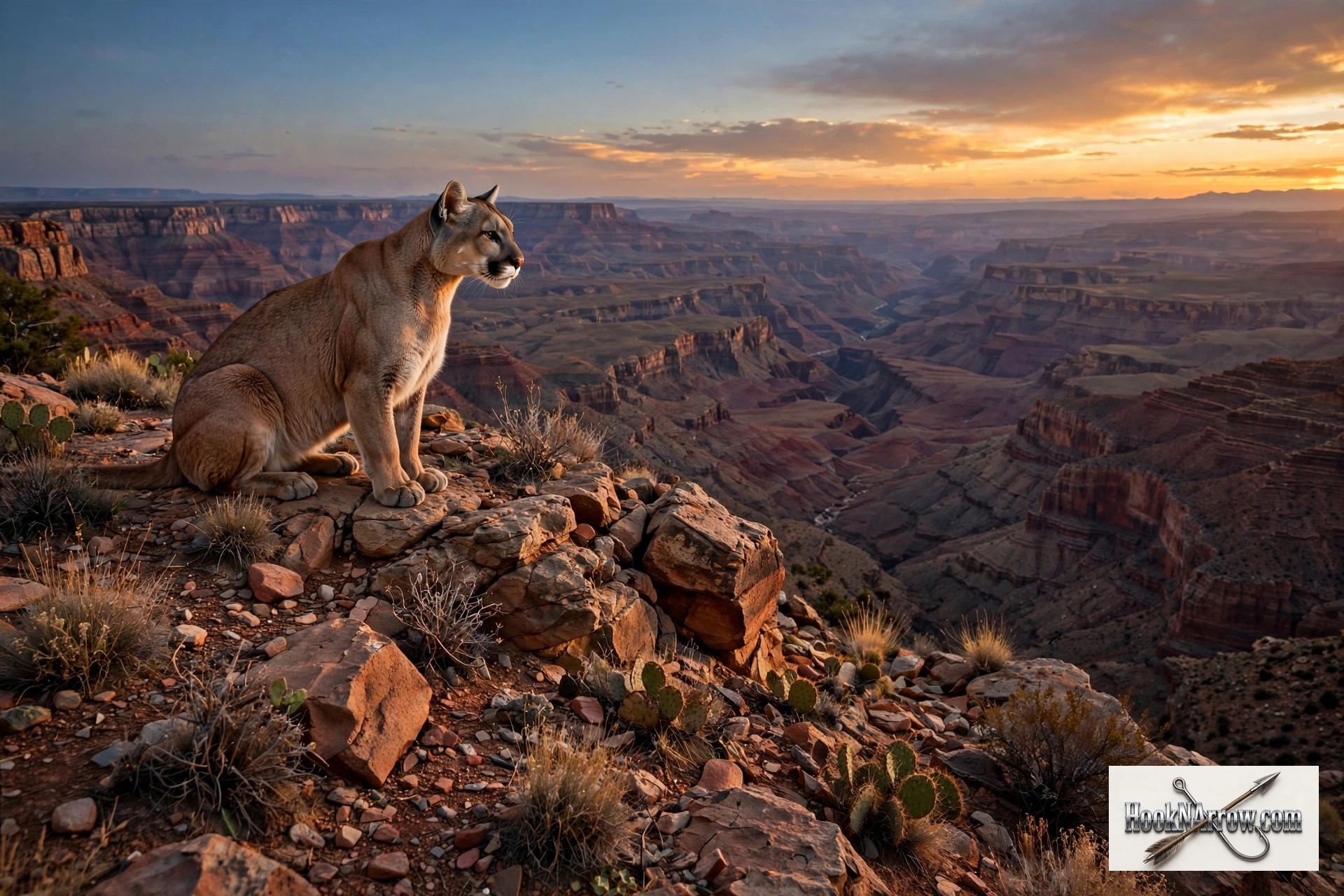
Mountain lion hunting is a different animal from deer hunting. You are not sitting over a feeder waiting — you are either running hounds through rimrock and canyon country, calling with distress sounds and waiting for a cat that comes in dead silent, or glassing huge stretches of West Texas or northern winter range hoping to cut a fresh track in the snow. The country is big, rough, and often a long way from the truck, and the cat you are after can cover miles without you ever knowing it was there.
The gear that matters most is the gear that finds lions and keeps you safe in lion country: a call that plays the right sounds, glass good enough to pick apart brushy draws at distance, a light for legal night work, and a way to call for help when you are miles from cell service. Here at HookNArrow.com we put together the five pieces of gear that earn their place on a lion hunt, whether you are calling cats in the Trans-Pecos of Texas or following hounds through fresh snow in Montana.
This guide covers five proven products: an electronic predator call, a hand call, a workhorse binocular, a night-hunting light kit, and a satellite communicator for backcountry safety.
Our Picks
FOXPRO Prowler Electronic Predator Call — best electronic call for lions
Calling is the most accessible way to hunt mountain lions — no hound pack required — and the call lives or dies on its sound library. The FOXPRO Prowler comes loaded with 75 premium sounds including mountain lion vocalizations and fawn distress, plus over 100 more from the free sound library, with room to store 300 total. The remote runs the call from over 200 yards out so the sound is away from you, which matters because a lion will circle downwind and come in looking at the sound source, not at you. It is made in the USA, weighs under a pound and a half with batteries, and the 3-year warranty is real backing from the biggest name in predator calls.
Who it’s for: The hunter who wants to call lions without investing in a hound pack — set the call 50 to 100 yards out, sit with the wind in your face, and let the fawn distress do the work.
Pros: Mountain lion and fawn distress sounds included out of the box; long remote range keeps the sound away from your position; light and packable at 1.45 pounds; expandable sound library via mini-USB.
Cons: Single horn speaker won’t match the volume of FOXPRO’s big multi-speaker units in wide-open country; batteries not included; cold weather eats alkalines — run lithium AAs in winter.
Purchase this item on Amazon →
Flextone Dying Rabbit Predator Call — best hand call
Every lion hunter should carry a mouth call even if they own an electronic caller — batteries die, remotes get left at the truck, and sometimes you need to coax, not broadcast. The Flextone Dying Rabbit’s flexible body lets you squeeze for a soft, close-range whine or open up for a loud long-distance wail, which is exactly the volume control you want when a cat is circling just out of sight. It is simple, weighs nothing, costs very little, and rabbit distress is one of the most proven lion sounds there is. Keep it on a lanyard around your neck on every stand.
Who it’s for: Every lion hunter — as a primary call for the minimalist or as the backup that saves the hunt when electronics fail.
Pros: Costs a fraction of an electronic call; flexible body gives real control over tone and volume; no batteries to die in the cold; proven rabbit distress sound lions respond to.
Cons: Takes practice to sound convincing — a bad caller educates cats fast; limited volume compared to an electronic call in big country; you are the sound source, so the lion is looking at you.
Purchase this item on Amazon →
Vortex Diamondback HD 10×42 Binoculars — best glass for lion country
Lion hunting is glassing hunting. Whether you are picking apart oak brush in the Texas Hill Country, scanning rimrock in the Trans-Pecos, or looking for a tawny shape bedded in northern timber, you need glass that resolves detail in low light without costing as much as your rifle. The Diamondback HD 10×42 hits that mark: HD optical system with good edge-to-edge clarity, fully multi-coated lenses for dawn and dusk work, waterproof and fogproof for winter hunts, and it ships with Vortex’s GlassPak harness so the binocular rides on your chest ready instead of bouncing on a neck strap. And the unconditional lifetime warranty means Vortex fixes or replaces it if you drop it off a canyon rim.
Who it’s for: The hunter who glasses hard — calling stands, track cutting, and spot-and-stalk in big western and Texas lion country.
Pros: Optical quality well above its price class; included chest harness is genuinely useful; unconditional lifetime warranty; waterproof, fogproof, and tough enough for rough country.
Cons: 10×42 is a do-everything size — dedicated long-range glassers may want 12x or 15x; 21 ounces is noticeable on long hikes; twist-up eyecups take some fiddling with gloves on.
Purchase this item on Amazon →
Wicked Lights ScanPro iC GEN4 3-Color Headlamp Kit — best night scanning light
Where night hunting for predators is legal — and it is in Texas and several other states — a red or green light is how you scan for eyeshine without spooking game the way white light does. The ScanPro iC GEN4 is a purpose-built night hunting headlamp: green, red, and white LEDs selectable by rotating the bezel, adjustable spot-to-flood beam, and an intensity control knob so you can run dim and creep up on brightness instead of blasting animals. The kit includes the charger, batteries, halo shield, and carry case, with roughly 600 yards of eyeshine detection range. For calling lions after dark or scanning for eyes on the way back to the truck, it beats a hardware-store headlamp by a mile.
Who it’s for: The night caller hunting where artificial light is legal — scan for eyeshine, identify your target, and keep your hands free.
Pros: Instant green/red/white switching without disassembly; intensity control prevents spooking light-shy cats; long eyeshine range for scanning; complete kit with batteries and charger.
Cons: Night hunting legality varies by state and species — check regulations first; headlamp-only design means you still need a weapon-mounted light for the shot; premium price for a headlamp.
Purchase this item on Amazon →
Garmin inReach Mini 2 — best backcountry safety gear
Lion country is remote country. The Trans-Pecos, the high desert, the northern Rockies in January — none of it has cell service, and a twisted ankle or a wrecked truck ten miles from pavement becomes a real emergency fast. The inReach Mini 2 talks to the Iridium satellite network for two-way texting and an interactive SOS button that reaches Garmin’s 24/7 response center, all in a 3.5-ounce unit that clips to your pack. It also does TracBack routing to walk you back to the truck and lets family follow your location on a MapShare page. It needs an active satellite subscription, but for solo lion hunters or anyone hunting new country, it is the cheapest life insurance you will ever buy.
Who it’s for: Anyone hunting lions solo or in remote country — which is most lion hunting — and anyone whose family worries when they disappear into the backcountry.
Pros: Two-way satellite messaging and SOS where phones are bricks; weighs almost nothing; up to 14 days of battery in tracking mode; TracBack routing and live location sharing.
Cons: Requires a paid satellite subscription on top of the device; tiny screen is fiddly — pair it with a phone for messaging; it is safety gear, not a hunting tool, so budget accordingly.
Purchase this item on Amazon →
What to Look For
Call sounds, not just call volume. For mountain lions specifically, you want fawn distress, elk calf, rabbit distress, and actual mountain lion vocalizations in the sound library. Generic predator sounds will call coyotes all day; lion-specific sounds are what pull a cat. Check the sound list before you buy — if the caller’s library is all coyote howls, keep shopping.
Glass that works at first and last light. Lions move at dawn, dusk, and night. Fully multi-coated lenses, good light transmission, and 42mm objectives gather the light you need when a cat steps out in the gray minutes. Waterproof and fogproof sealing is non-negotiable for northern winter hunts.
Light discipline. If you hunt where night calling is legal, red and green LEDs with adjustable intensity are the standard — predators are less sensitive to them, and starting dim keeps you from flaring every animal in the county. White light is for recovery and camp, not for scanning.
A comms plan for no-service country. Lion hunting puts you miles from pavement in rough terrain. A satellite communicator, a charged phone in airplane mode with offline maps, and telling someone your plan and return time are the baseline. Do not skip this because the weather looks fine.
Pack for the walk out, too. A lion is 100-plus pounds of cat in country you probably hiked into. Game bags, a sharp knife, paracord, and a pack that can haul meat matter as much as the call that brought the cat in. Plan the pack-out before you pull the trigger.
Know the law cold. Mountain lion regulations vary enormously: Texas treats lions as nongame with no closed season, while most western states require tags, have defined seasons and harvest quotas, and mandate check-in of the hide and skull. Some states restrict hound hunting or night hunting. Read your state’s current regulations every season — they change, and the penalties for getting it wrong are severe.
Mountain Lion Hunting Tips
- Call longer than feels reasonable. Lions are not coyotes — they may take 45 minutes or more to work into a call, circling silently downwind the whole way. Settle in for long stands and do not stand up the moment the sound stops.
- Watch downwind, always. A lion will almost always circle to get the wind before committing. Set your call upwind of your position and keep your eyes on the downwind side. Most blown lion stands end with the hunter never seeing the cat that smelled him.
- Hunt fresh snow in the north. The classic northern lion hunt starts with cutting a fresh track at daylight and following hounds or working the track on foot. A fresh snow is the single biggest advantage a lion hunter can get — learn to tell a lion track from a big dog track before you go.
- Start soft, build volume. Open a stand with quiet distress sounds. A lion close by will hear a whisper; a lion a mile out needs volume. Blasting full volume from the first minute educates every cat within earshot.
- Bring a partner. Two sets of eyes cover twice the circle, and a partner is your backup in genuinely remote country. Lion hunting is one of the pursuits where hunting alone adds real risk.
- Confirm the target before the shot. In brush and low light, a bobcat, a coyote, or even a big feral dog can fool tired eyes at distance. Glass it, confirm it is a lion, confirm it is legal — then shoot. There are no do-overs on a misidentified animal.
FAQ
Is mountain lion hunting legal? It depends entirely on where you are. Texas classifies mountain lions as nongame animals with no closed season. Most western states — Colorado, Montana, Idaho, Utah, Wyoming, New Mexico, Arizona, and others — manage lions as big game with tags or permits, defined seasons, and harvest quotas that can close a unit mid-season. California banned mountain lion hunting. Rules on hound hunting, baiting, and night hunting vary just as much. Check your state wildlife agency’s current regulations before you plan anything.
What is the best way to hunt mountain lions — hounds or calling? Hounds are the most consistently effective method where legal, because dogs can follow a track to a treed or bayed cat — but running a hound pack is a lifestyle, not a weekend hobby. Calling with distress sounds is the most accessible method for the average hunter and works in Texas and across the West. Spot-and-stalk is the hardest way to kill a lion and succeeds rarely; most stalk-killed lions are animals stumbled into rather than deliberately stalked.
What sounds work best for calling mountain lions? Fawn and elk calf distress are top producers, along with rabbit distress and mountain lion vocalizations themselves — a female in heat or kittens mewling can pull a tom looking for a fight or a meal. Run the sound for at least 30 to 45 minutes per stand, starting soft. And remember the cat comes in silent, so your eyes matter more than your ears.
Can you hunt mountain lions at night? In some states, yes — Texas allows night hunting of nongame animals including lions, and several other states allow night predator hunting with restrictions on lights and methods. Many western big-game states prohibit hunting lions at night. Night vision and thermal legality also varies by state and species. Verify your state’s current rules before heading out after dark.
What caliber is enough for mountain lion? Lions are thin-skinned but tough, and shots are often quick at moderate range. Common choices run from .243 Winchester and 6.5 Creedmoor up through .270 and .30-06 — flat-shooting deer-class cartridges all do the job with good shot placement. Check your state for any caliber or method minimums, and use a quality expanding bullet rather than varmint bullets that can fail to penetrate.
Do I need a guide to hunt mountain lions? Not legally in most places, but for a first lion hunt it is money well spent. A good houndsman or experienced caller knows the country, reads sign you would walk past, and handles the dogs, the track, and the shot sequence. If you go DIY, start by learning to identify tracks and sign, scout relentlessly, and consider that your first season may be more education than harvest.
As an Amazon Associate I earn from qualifying purchases.
Keep Reading: More Buying Guides
Fishing:
- Best Saltwater Fishing Gear 2026
- Best Fly Fishing Gear 2026
- Best Catfishing Gear 2026
- Best Baitcasting Reels for Texas Anglers (2026)
- Best Bass Fishing Rods for Texas Anglers (2026)
- Best Crappie Fishing Gear for Texas (2026 Guide)
- Best Fishing Apparel for Texas Heat (2026 Guide)
- Best Fishing Line for Bass (2026)
- Best Tackle Boxes and Tackle Storage for Anglers (2026)
Hunting:
- Best Bear Hunting Gear 2026
- Best Elk Hunting Gear 2026
- Best Binoculars for Texas Hunting (2026 Guide)
- Best Deer Hunting Scopes for Texas (2026 Guide)
- Best Hunting Knives for Texas Hunters (2026 Guide)
- Best Thermal Scopes for Hog & Predator Hunting (2026 Guide)
- Best Trail Cameras for Whitetail (2026)
Leave a Reply