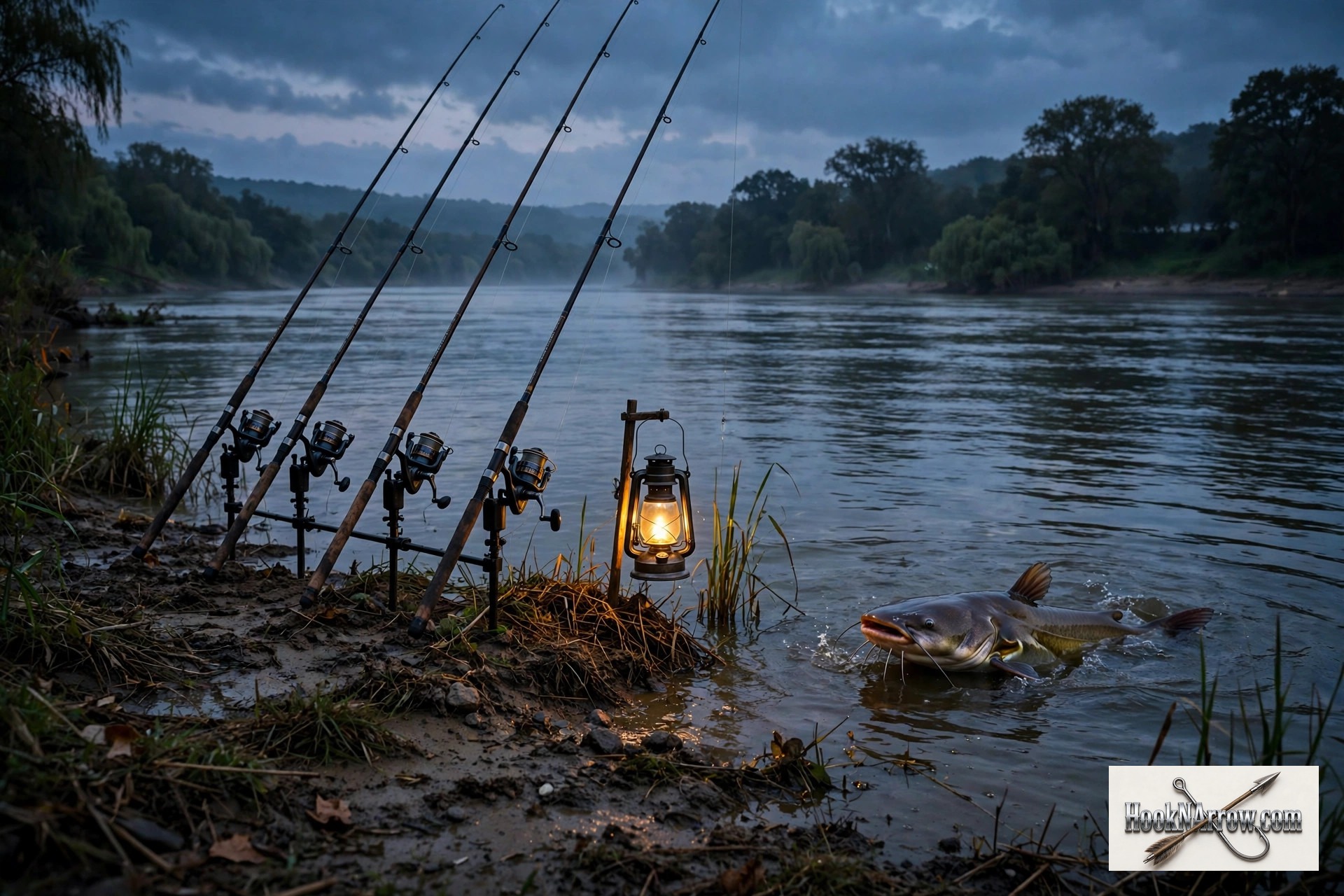
Catfishing is the most democratic big-fish game in America. You don’t need a boat that costs more than your truck — a stout rod, a reel with real drag, sharp circle hooks, and something that stinks is enough to tangle with a 40-pound blue cat. Channel cats fill farm ponds and city lakes, blue cats roam the big reservoirs, and flatheads own the rivers and logjams. All three pull harder than anything else in freshwater at their size, and they live in places full of current, rocks, and timber that will punish light tackle.
Catfish gear is built around a simple truth: the fish finds the bait, picks it up, and runs — your job is to survive that first run and turn the fish. That means medium-heavy to heavy rods with enough backbone to move a big fish in current, reels with smooth, strong drags and plenty of line capacity, circle hooks that set themselves in the corner of the mouth, and sinkers that stay put on the bottom instead of rolling downstream. Finesse has no place here. Buy tough, buy simple, and spend your money on terminal tackle — hooks and line are where catfish are actually won and lost.
This guide explains what to look for in catfish gear and covers five proven picks: a rod and reel that form the backbone of a bank or boat setup, the circle hooks most serious catmen trust, no-roll sinkers for fishing current, and a prepared bait that catches channels and blues when fresh bait isn’t an option.
What to Look For
Rod power and action. Medium-heavy to heavy power is the standard for catfishing — you need backbone to drive a big hook home and muscle a fish out of cover. Moderate or moderate-fast action is the sweet spot: the softer tip lets a catfish take the bait without feeling resistance (critical with circle hooks), while the lower two-thirds of the rod does the heavy lifting. Seven to eight feet is the versatile range — long enough to cast heavy sinkers and bait from the bank, short enough to manage in a boat. Look for durable guides; cheap inserts pop out when you’re horsing braid through them.
Reel strength and line capacity. A catfish reel needs two things: a smooth, strong drag and enough line capacity to survive a long run. Round baitcasting reels are the traditional choice for big blues and flatheads — they hold more heavy line and their drags are built for punishment. Big spinning reels (5000 size and up) work fine for channels and general duty. Either way, look for 20+ pounds of max drag and the capacity to hold 150+ yards of 30- to 50-pound line. A bait clicker (line-out alarm) is a genuinely useful feature for still-fishing — you’ll hear the run before you see the rod tip move.
Circle hooks. This is the single most important piece of catfish tackle. Circle hooks set themselves — the fish takes the bait, turns, and the hook slides into the corner of the mouth as the line tightens. Don’t jerk the rod; just let it load up or reel steadily. Inline (non-offset) circle hooks are required in some waters and are the conservation-friendly choice everywhere. Size up with your bait and your target: 5/0 to 7/0 covers most channel cat and eater-blue fishing, 8/0 to 10/0 for trophy blues and flatheads on big cut bait. Buy sharp, buy strong, and never straighten a cheap hook on a good fish.
Sinkers that stay put. Catfish live on the bottom, often in current, so your sinker has to hold your bait in the strike zone instead of tumbling downstream. Flat disc or no-roll sinkers are the answer for rivers — their shape grips the bottom and resists rolling. Egg sinkers work for Carolina-style rigs in lakes where the fish can take line freely. Match weight to current: an ounce or two for lakes and slow water, three to eight ounces (or more) for heavy river current. Buy in bulk — you will donate plenty of lead to the river gods.
Line. Braided line in 40- to 65-pound test is the modern standard for catfishing: no stretch for solid hooksets, thin diameter for its strength, and it saws through nothing — it just doesn’t break. Monofilament in 25- to 40-pound test still has its fans for the stretch that cushions surging fish and for anglers who fish a lot of abrasive rock. Either way, run a heavy monofilament or fluorocarbon leader (40- to 80-pound) for abrasion resistance around timber, rocks, and a catfish’s sandpaper mouth.
Bait. Fresh cut bait — shad, skipjack, bluegill — is the undisputed king for blue cats and flatheads; nothing manufactured beats the real thing. But fresh bait isn’t always available, which is where prepared dip, punch, and dough baits earn their keep, especially for channel cats. The best prepared baits are sticky enough to stay on a dip worm or treble hook and stinky enough to pull fish from a distance. Match the bait to the species: channels love prepared stink baits, blues want fresh cut bait, flatheads want live bait.
Our Picks
Ugly Stik Catfish Special Spinning Rod — best all-around catfish rod
The Catfish Special is purpose-built for exactly what its name says: casting for catfish from banks, shores, and dams. The 7-foot medium-heavy blank uses Ugly Stik’s Ugly Tech graphite-and-fiberglass construction, so it has the backbone to handle big fish with a tip sensitive enough to read light bites — the Clear Tip design puts extra strength right where strikes register. One-piece Ugly Tuff stainless guides won’t pop inserts under heavy braid, the full rubberized shrink-wrap handle grips well with wet or slimy hands, and it carries a 7-year rod warranty. This is the rod that lives in the truck bed and never complains.
Who it’s for: The bank angler or weekend catman who wants one tough, affordable rod that handles channels, eater blues, and the occasional surprise flathead.
Pros: Genuinely tough graphite/fiberglass blank at a workingman’s price; sensitive Clear Tip for a heavy-power rod; one-piece stainless guides eliminate insert pop-out; 7-year warranty.
Cons: A spinning rod isn’t the ideal match for a round baitcaster setup — pair it with a big spinning reel; 7 feet can feel short for extreme long-distance bank casting; not enough rod for true trophy-blue specialists.
Purchase this item on Amazon →
KastKing Rover Round Baitcasting Reel — best round reel for big cats
The Rover is a classic-style round baitcaster built for exactly the kind of abuse catfishing dishes out. The reinforced aluminum frame, stainless steel components, and carbon fiber drag system deliver up to 30 pounds of max drag (size dependent), with 4+1 or 6+1 stainless bearings depending on size. It comes in sizes from 40 up to 90, so you can match the reel to your quarry — a 60 for channels and eater blues, a 70 or 80 when you’re hunting true giants. The line-out clicker alarm is worth its weight in gold for still-fishing: set the rod in a holder, engage the clicker, and you’ll hear the take before anything else happens.
Who it’s for: The angler chasing blue cats and flatheads who wants traditional round-reel cranking power, big line capacity, and a drag that won’t fade on a long run.
Pros: Strong carbon drag system with up to 30 pounds of stopping power; wide size range from 40 to 90 to match any catfish application; line-out clicker for rod-holder fishing; metal construction at a price that undercuts the legacy round reels.
Cons: Round reels are heavier than low-profile baitcasters — your wrist will know after a long day of casting; the classic design has a learning curve if you’ve only used spinning gear; finish and tolerances aren’t at the level of reels costing three times more.
Purchase this item on Amazon →
Gamakatsu Octopus Circle Inline Point Hooks (25-Pack, 7/0) — best catfish hooks
Ask a room full of serious catfishermen what hook they trust and Gamakatsu circle hooks will win the vote. This 25-pack of 7/0 inline-point Octopus Circle hooks hits the sweet spot for most catfishing — big enough for chunk cut bait and live bluegill, with Gamakatsu’s famously sharp, consistent points that penetrate on the turn without a hard hookset. The inline (non-offset) point is legal everywhere circle hooks are required and hooks cleanly in the corner of the mouth for easy release. Twenty-five hooks per pack means you can re-tie without doing terminal-tackle math on the tailgate.
Who it’s for: Any catfish angler running cut bait or live bait who wants hooks that set themselves and hold — from pond channels to reservoir blues.
Pros: Razor-sharp out of the pack with excellent quality control; inline point is regulation-friendly and promotes clean corner-of-mouth hooksets; 7/0 is a true all-arounder size; 25-pack is good value for a premium hook.
Cons: Premium hooks cost more than bulk bargain brands — you’ll feel every snag; 7/0 is small for trophy-class blues on whole skipjack (size up to 10/0); you still have to check points and replace dulled hooks.
Purchase this item on Amazon →
Rotatingpals Disc Sinkers (2 oz, 36-Pack) — best no-roll sinkers for current
The flat coin shape is the whole idea: disc sinkers lay flat on the bottom and resist rolling in current far better than round bank sinkers, so your bait stays in the strike zone instead of tumbling into the next county. These 2-ounce discs suit moderate river current and Carolina-style rigs, the smooth center hole won’t abrade your line, and the 36-pack means losing a few to snags doesn’t sting. Two ounces is a versatile middle weight — enough to hold in real current, light enough for controlled drifts and lake fishing.
Who it’s for: River catfishermen who fish current and need their bait to stay put, plus anyone tired of re-casting every ten minutes.
Pros: Flat disc profile genuinely resists rolling in current; smooth holes protect line; 36-pack bulk value for a consumable you will lose; 2 oz is a versatile do-most-things weight.
Cons: Two ounces won’t hold in heavy flood-stage current — you’ll need heavier discs for that; disc sinkers snag in rocks about as readily as anything; bulk packaging, no fancy tackle-box-ready container.
Purchase this item on Amazon →
Team Catfish Secret 7 Dip Bait — best prepared catfish bait
When you can’t get fresh shad, Secret 7 is the prepared bait that actually produces. The silky, sticky blend of fish attractants loads easily onto dip tubes and worms, puts out a serious scent trail, and has a tournament track record — it’s won events on the national catfish circuits. It’s at its best on channel cats and blue cats in ponds, lakes, rivers, and streams. Yes, it stinks. That’s the point. Keep a dedicated bait towel and don’t wear your good shirt.
Who it’s for: Channel cat anglers and anyone who needs a ready-to-fish bait without netting shad at dawn — pond hoppers, bank fishermen, and kayak catmen especially.
Pros: Proven tournament-winning formula, not just marketing; sticky texture stays on dip worms and tubes; effective on both channels and blues; no refrigeration or live-bait logistics.
Cons: It smells awful to humans and the smell lingers on skin and gear; flatheads largely ignore prepared baits — they want live bait; you’ll need dip tubes or worms, which is an extra purchase if you don’t own them.
Purchase this item on Amazon →
Catfishing Tips
- Don’t set the hook on circle hooks. This is the number-one mistake. With the rod in a holder and the clicker on, let the fish take the bait and turn — the circle hook slides into the corner of the mouth on its own. When the rod loads up, just pick it up and reel. Jerking pulls the bait (and the hook) right out of the fish’s mouth.
- Fresh bait beats everything for blues and flatheads. Fresh-cut shad or skipjack is the gold standard for blue cats; live bluegill or bullheads are what big flatheads want. Prepared dip baits are excellent for channels, but if you’re specifically hunting trophy blues or flatheads, put in the time to get fresh or live bait.
- Fish the current seams. In rivers, catfish hold where fast water meets slow water — below dams, at creek mouths, along outside bends, behind wing dams and logjams. Cast upstream of the seam and let your sinker settle right on the break. In lakes, look for creek channels, humps, and flats adjacent to deep water.
- Fish at night in summer. Big catfish, especially flatheads, feed most aggressively after dark in warm months. Set up on a good bank spot an hour before sunset, get your baits out, and settle in. Bring more bug spray than you think you need.
- Use rod holders and clickers. Catfishing is a waiting game, and a proper rod holder with the reel’s bait clicker engaged means you never miss a run — and your rod never goes swimming. PVC bank holders cost almost nothing and save expensive setups.
- Handle big cats with respect. Lip-gripping a big blue or flathead like a bass is a good way to get a treble-equivalent surprise from dorsal and pectoral spines — they will puncture a hand. Use lip grippers or a firm grip behind the gills, support the belly on truly big fish, and get them back in the water quickly.
FAQ
What’s the best bait for catfish? It depends on the species. Fresh cut bait — shad, skipjack, bluegill chunks — is the top choice for blue cats. Live baitfish are the ticket for flatheads. Channel cats are the least picky and crush prepared dip and punch baits like Secret 7, plus nightcrawlers, chicken liver, and shrimp. If you only pick one all-arounder for channels and eater-size blues, fresh cut shad is hard to beat.
Should I use circle hooks or J-hooks for catfish? Circle hooks, in most situations. They set themselves in the corner of the mouth, which means better hookup ratios for anglers fishing rod holders — and far fewer gut-hooked fish, which matters if you release fish. J-hooks (like Kahle or treble hooks) still have a place with prepared dip baits and when you’re holding the rod and setting the hook yourself. Some waters require circle hooks, so check your state regulations.
What pound test line do I need for catfish? For general channel cat and eater-blue fishing, 20- to 30-pound mono or 40- to 50-pound braid covers it. If you’re targeting trophy blues or flatheads in heavy cover or current, step up to 50- to 65-pound braid with an 80-pound leader. The leader matters as much as the main line — a catfish’s mouth and the rocks it lives around will shred light leaders.
Do I really need a special rod for catfishing? You need a rod with enough power, but it doesn’t have to say “catfish” on it. Any medium-heavy to heavy rod rated for the line and lure weights you’re throwing will work — heavy bass rods, inshore saltwater rods, and downrigger rods all catch catfish. Dedicated catfish rods just get the details right: longer handles for two-handed casts with heavy sinkers, durable guides, and actions tuned for circle hooks.
When is the best time to catch catfish? Catfish bite year-round, but the prime windows are spring (pre-spawn feeding) and summer nights. Flatheads are famously nocturnal in summer — after dark is when the giants move. Blue cats feed aggressively in winter on deep wintering holes, which surprises a lot of people. Overcast, stable weather days beat bright, high-pressure afternoons just about everywhere.
Can I catch big catfish from the bank? Absolutely — some of the biggest catfish ever caught came from shore. The keys are access to the right water (below dams, creek mouths, deep holes within casting range), gear that can cast heavy sinkers and bait long distances, and patience. A 9- to 10-foot rod helps bank anglers reach distant current seams, and a good rod holder keeps everything in place while you wait.
As an Amazon Associate I earn from qualifying purchases. Prices and availability change — HookNArrow.com only recommends gear we’d fish ourselves.
Keep Reading: More Buying Guides
Fishing:
- Best Baitcasting Reels for Bass Fishing (2026 Guide)
- Best Bass Fishing Rods (2026 Guide)
- Best Crappie Fishing Gear: Rods, Reels, Jigs & Minnow Rigs
- Best Fishing Apparel for Hot Weather: Stay Cool and Sun-Safe on the Water
- Best Fishing Line for Bass — Mono vs. Fluorocarbon vs. Braid
- Best Tackle Boxes and Tackle Storage for Anglers (2026)
- Best Saltwater Fishing Gear 2026
- Best Fly Fishing Gear 2026
Hunting:
- Best Binoculars for Hunting (2026) — What Actually Works in the Field
- Best Deer Hunting Scopes (2026 Guide)
- Best Hunting Knives for Deer and Hogs (2026)
- Best Thermal Scopes for Hog & Predator Hunting (2026 Guide)
- Best Trail Cameras for Whitetail (2026)
- Best Bear Hunting Gear 2026
- Best Elk Hunting Gear 2026
- Best Mountain Lion Hunting Gear 2026
Leave a Reply